How much do scratch offs cost? Custom scratch off cards typically cost between $0.12 and $2.37 per card, depending almost entirely on quantity. Small runs of 100 cards run roughly $2.00–$2.95 each ($175–$295 total), while orders of 10,000+ drop to around $0.12–$0.15 per card. At Just Scratch It, custom cards start near 12¢ per card at 10,000 units with design included. A DIY batch of 50 cards costs about $10–$20 in materials.
If you’ve searched “how much do scratch offs cost,” you’ve probably noticed something frustrating: almost nobody gives you a straight number. The lottery pages talk about $1, $2, $5, $10, $20, and $30 state lottery tickets. The printing companies hide pricing behind a “request a quote” button. And the DIY tutorials wave their hands at “a few bucks.”
This guide fixes that. Below you’ll find real per-card pricing pulled from live vendor price tables, a full breakdown of every factor that moves the price up or down, the actual math on DIY vs. professional printing, and the data on what scratch off cards return when used for marketing — because “how much do they cost” and “are they worth it” are really the same question.
Quick Answer: Scratch Off Pricing at a Glance
There are two completely different products people mean by “scratch offs,” so let’s separate them first.
| What you mean | Typical cost | Who buys it |
|---|---|---|
| State lottery scratch tickets | $1 – $30 per ticket (face value) | Consumers playing the lottery |
| Custom scratch off cards (marketing, promos, fundraising, events) | $0.12 – $2.37 per card | Businesses, schools, event hosts |
This article is about the second category — custom printed scratch off cards you order for a promotion, a direct mail campaign, an event, a fundraiser, or a giveaway. (If you landed here looking for lottery odds, you want your state lottery’s website, not a printer.)
For custom cards, the single biggest driver of price is how many you order. Everything else — size, finish, design, personalization — matters, but quantity is the lever that moves cost from nearly $2.40 a card down to pennies.
How Much Do Custom Scratch Off Cards Cost by Quantity?
Here’s the part the quote-gated printers don’t want you to see on the first click. The table below reflects real published per-card pricing for a standard business-card-size scratch off card (full color, one scratch panel), aggregated from live online print vendors in 2026:
| Quantity | Approx. price per card | Approx. total |
|---|---|---|
| 100 | $2.37 | $237 |
| 300 | $1.14 | $342 |
| 500 | $0.84 | $420 |
| 1,000 | $0.55 | $550 |
| 2,000 | $0.40 | $800 |
| 4,000 | $0.25 | $1,000 |
| 6,000 | $0.19 | $1,140 |
| 10,000 | $0.15 | $1,500 |
| 25,000+ | $0.12 or lower | $3,000+ |
The pattern is unmistakable: the per-card price falls by roughly 94% from a 100-card order to a 25,000-card order. Scratch off printing is dominated by setup costs — plates, color calibration, the scratch-coating pass, die-cutting — and those are fixed no matter how many cards you run. Spread across 100 cards, setup is brutal. Spread across 10,000, it nearly disappears.
Why do small scratch off orders cost so much per card? Scratch off printing carries high fixed setup costs — printing plates, scratch-coating application, die-cutting, and color calibration — that don’t change whether you print 100 cards or 10,000. On a 100-card run those costs are divided across only 100 cards, so each one absorbs a big share. On large runs, setup is spread thin and the per-card price collapses toward $0.12–$0.15.
What this means for your budget
- Need fewer than 250 cards? Expect to pay $1–$2.50 each. Honestly, at this volume, DIY (covered below) is often the smarter move unless you need a polished, branded look.
- Ordering 500–2,000? This is the sweet spot for most small-business promotions and events. You’re paying $0.40–$0.85 per card and getting professional print quality.
- Running a direct mail or large retail campaign (5,000+)? You’re now in $0.12–$0.20 territory, which is where scratch cards become one of the cheapest high-engagement marketing assets you can buy.
Why Do Scratch Off Cards Cost More Than Regular Printed Cards?
A standard full-color business card at 1,000 units might cost you 3–8 cents each. A scratch off card at the same quantity runs 50+ cents. Where does the extra money go?
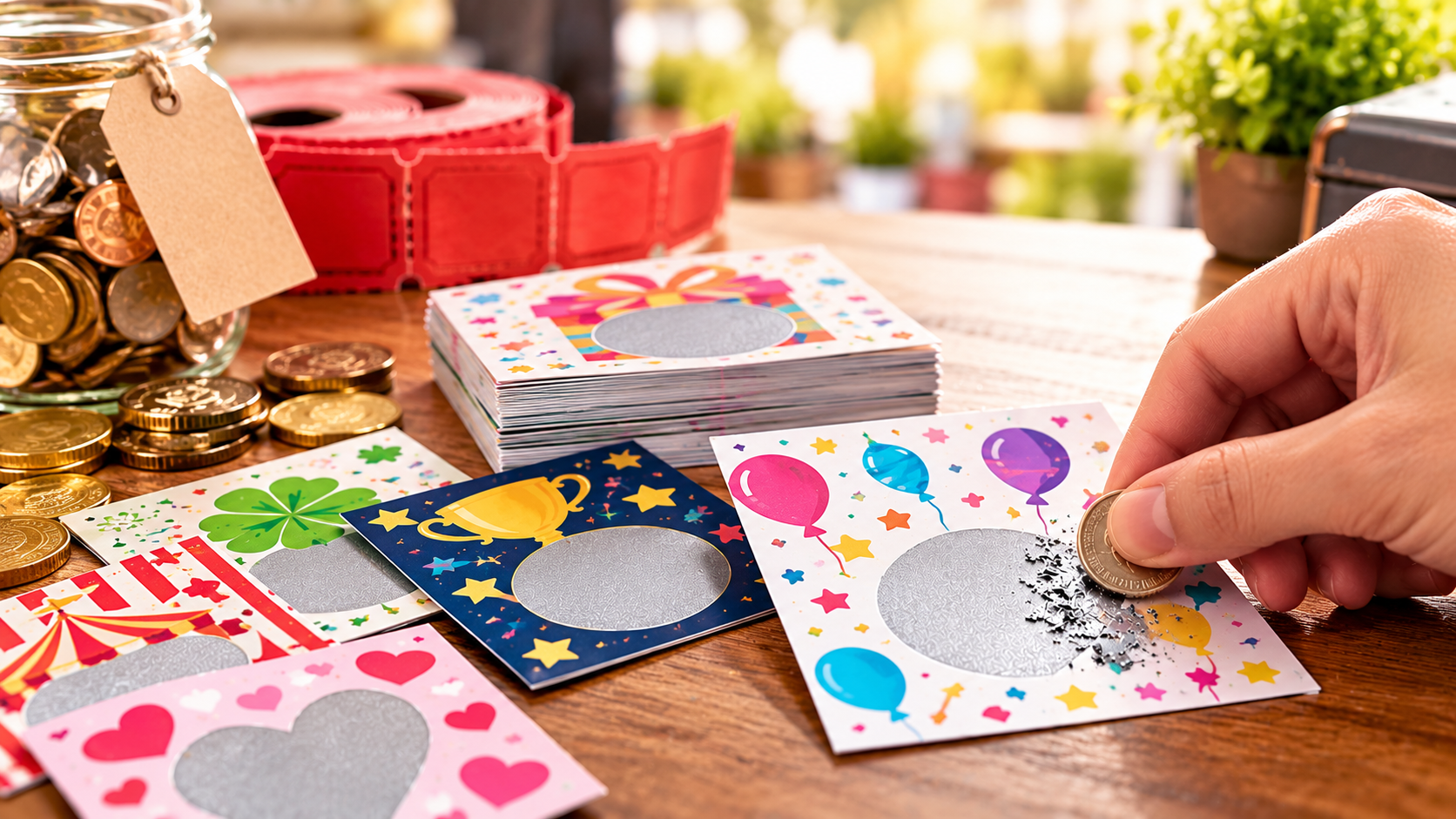
- The scratch coating itself. That silver or gold panel is a separate layer — usually a latex-based or metallic opaque ink — applied in its own press pass or by a dedicated scratch-off machine. It’s an extra material and an extra production step.
- The hidden layer. Before the scratch coating goes on, your variable prize/code/message is printed underneath. If every card is identical, that’s cheap. If every card is different (unique codes, personalized names), that requires variable data printing (VDP) — more on that below.
- Security printing. Legitimate promotional scratch cards use “confusion printing” — random symbols or patterns printed under the coating around the real prize — so winners can’t be detected by holding the card to light. This adds design and press complexity.
- Thicker stock. Scratch cards are usually printed on heavier card stock (so the scratch action doesn’t tear through) and often laminated, which costs more than standard paper.
- Die-cutting and finishing. Custom shapes, rounded corners, perforations, and folding all add finishing passes.
So the premium isn’t a markup — it’s a genuinely more complex product.
The 10 Factors That Change Your Scratch Off Price
Beyond quantity, here’s everything that moves your quote up or down. Use this as a checklist when comparing vendors so you’re comparing apples to apples.
1. Quantity. Already covered — by far the biggest factor. Always ask for pricing at the next tier up; the jump is often tiny relative to how many more cards you get.
2. Card size. A standard business-card size (3.5″ × 2″) is cheapest because it nests efficiently on a press sheet. Postcard sizes (for direct mail) and oversized cards cost more per unit.
3. Scratch panel size and count. One small panel is standard. Multiple panels (think a tic-tac-toe or match-3 game) or a full-card scratch coating use more material and cost more.
4. Color. Full-color (CMYK) both sides is the norm now and priced accordingly. One-color or black-only can shave cost on very large runs.
5. Variable data / personalization. Printing a unique code, serial number, or recipient’s name on every card requires VDP. This is where a lot of the value is for marketing (trackable codes, “You’re a winner” mechanics), but it adds cost — typically a per-record or setup fee.
6. Prize structure and odds design. If you want a managed “everyone wins” structure (e.g., 70% small prize / 25% mid / 5% grand), properly randomized and confusion-printed, that’s a design/consulting layer some vendors include and others charge for.
7. Stock and thickness. Heavier stock, premium matte or gloss, recycled stock — each nudges price.
8. Finish and extras. Lamination, foil, spot UV, rounded corners, perforation, folding (for mailers).
9. Design services. Supplying print-ready artwork is cheapest. If the vendor designs the card for you, expect a design fee — though some, including Just Scratch It, include design in the per-card price, which materially changes the real cost comparison.
10. Turnaround and shipping. Standard production is baked into the quote. Rush jobs cost a premium. Shipping on heavy card stock in volume is a real line item — always get it quoted before you commit.
What’s the single best way to lower scratch off card cost? Order in the largest quantity you can realistically use. Because setup costs are fixed, moving from 500 cards to 1,000 often costs far less than double — sometimes only 30–40% more for twice the cards. The second-best lever is supplying your own print-ready design to avoid design fees, and the third is choosing a standard size and a single scratch panel.
DIY vs. Professional: The Real Cost Math
A huge share of “how much do scratch offs cost” searches come from people planning a small, personal run — a gender reveal, a date-night card, a small classroom reward, a wedding save-the-date. For these, DIY is genuinely viable. Here’s the honest comparison.
DIY scratch off cost
The homemade method: print or write your message on cardstock, cover it with clear packing tape, then paint over the tape with a 2:1 mix of metallic acrylic paint and dish soap (the dish soap lets it scratch off later).
| DIY component | Approx. cost |
|---|---|
| Cardstock (50+ sheets) | $5–$8 |
| Metallic acrylic paint | $4–$7 |
| Dish soap | Already in your kitchen |
| Clear packing tape | $3–$5 |
| Scratch-off sticker labels (shortcut option) | $6–$10 for 100+ |
| Total for ~50 cards | $10–$20 |
That’s roughly $0.20–$0.40 per card in materials — but it costs you time, the finish is inconsistent, and it won’t look professional or carry secure confusion printing. Perfect for a reveal or a party; wrong for a brand campaign.
Professional printing cost (same 50 cards)
At 50–100 units, professional printing runs $2.00–$2.95 per card, so your 50-card order lands around $100–$150. You’re paying for consistency, a branded look, durable stock, and (if needed) unique codes and secure printing.
The crossover
- Personal, one-off, fewer than ~100 cards, look doesn’t need to be perfect → DIY wins on cost.
- Any business use, any branded look, any need for unique codes or scale → professional wins the moment you factor in your time and the credibility a cheap-looking card costs you.
How to Get the Lowest Price on Scratch Off Cards
Five concrete moves, in order of impact:
- Size the order to the next tier. Before you order 800, price 1,000. The marginal cards are nearly free compared to the setup you’ve already paid for.
- Supply print-ready artwork (or pick a vendor that includes design, so it’s a wash).
- Stick to a standard size and one scratch panel unless the game mechanic genuinely needs more.
- Bundle campaigns. If you run quarterly promotions, print the year’s cards in one run and store them. One setup, four campaigns.
- Get an all-in quote. Insist that design, data/personalization, and shipping are in the number. A low per-card price with surprise fees on top is the oldest trick in print.
What Do You Actually Get for the Price? (The ROI Case)
Here’s why businesses happily pay 15¢–55¢ a card: scratch cards get interacted with at rates almost nothing else in marketing can match.
- Scratch off cards see response/redemption rates commonly cited in the 30–50% range for well-run promotions — a figure driven by the simple fact that a sealed panel is almost impossible not to scratch.
- According to the Association of National Advertisers (ANA) / DMA Response Rate Report, direct mail achieves around a 4.4% response rate, versus roughly 0.12% for email — and adding a tactile, interactive element like a scratch panel is a well-documented way to push mail response higher still.
- The psychology is variable-reward gamification: the same mechanic that makes slot machines and loot boxes compelling makes a scratch panel irresistible. You’re not selling the prize; you’re selling the scratch.
Run the math on a 5,000-card direct mail drop at ~$0.19/card: that’s about $950 in cards. If even a conservative slice of recipients scratch and redeem, the cost-per-engaged-customer is a rounding error next to most paid digital channels. That’s the real answer to “are they worth it” — and it’s why the cost question matters less than it first appears.
Are scratch off cards expensive for marketing? No — they’re among the cheapest high-engagement tools available. At scale, custom scratch cards cost roughly $0.12–$0.20 each, while driving redemption rates far above email or standard mail. A 5,000-card campaign costs under $1,000 in cards, and because a sealed scratch panel is almost always scratched, the cost per engaged recipient is extremely low compared to digital advertising.
Scratch Off Cost FAQ
How much do scratch off cards cost per card? Custom scratch off cards cost about $0.12–$2.37 each. Small runs (100 cards) are ~$2.37/card; large runs (10,000+) drop to ~$0.12–$0.15/card because fixed setup costs spread across more units.
How much does it cost to print 1,000 scratch off cards? Roughly $0.55 per card, or about $550 total for a standard full-color, single-panel business-card-size run — before any design, personalization, or shipping extras.
How much do scratch offs cost to make yourself (DIY)? About $10–$20 in materials for ~50 cards (cardstock, metallic acrylic paint, dish soap, clear tape), or roughly $0.20–$0.40 per card — plus your time, with a less polished result.
Why are custom scratch cards more expensive than regular cards? Because of the extra scratch-coating layer, a hidden printed layer underneath, security “confusion printing,” heavier stock, and die-cutting — all production steps a plain printed card doesn’t need.
Does personalization raise the cost? Yes. Printing a unique code or name on every card requires variable data printing (VDP), which adds a setup or per-record fee — but it’s what makes cards trackable and enables “winner” mechanics.
What’s the cheapest quantity to order? Per card, the more you order the cheaper it gets. Per order, 100 is the smallest typical minimum. If you need under 100 and don’t need a branded look, DIY is cheaper.
How much do design fees add? It varies — some vendors charge a separate design fee, others (including Just Scratch It) include design in the per-card price, which can make a slightly higher sticker price the cheaper all-in deal.
Do scratch off cards have minimum orders? Most professional printers set minimums around 100–250 cards. Below that, you’re usually better off with DIY or sticker labels.
How much should I budget for a scratch off marketing campaign? For a solid mid-size campaign, budget around $500–$1,500 for the cards themselves (1,000–6,000 units), plus design (if not included) and shipping. The engagement rates typically justify the spend.
Are scratch off cards worth the cost? For engagement, yes — redemption rates of 30–50% and direct-mail response well above email make the per-card cost easy to justify, especially at volume where cards cost pennies.
The Bottom Line
How much do scratch offs cost? Between 12¢ and about $2.37 per custom card, with quantity as the dominant lever. Small personal runs favor DIY at $10–$20 for a batch; business and marketing runs favor professional printing, which gets dramatically cheaper the more you order and delivers engagement rates most channels can’t touch.
If you’re pricing cards for a promotion, event, fundraiser, or direct mail campaign, the smart move is to get an all-in quote (design, personalization, and shipping included) at the quantity you actually need — and to price the next tier up before you commit, because the extra cards are almost always nearly free.
Just Scratch It builds custom scratch off cards for businesses with design included and per-card pricing that starts near 12¢ at volume — so you can see your real, all-in cost up front instead of chasing a quote.