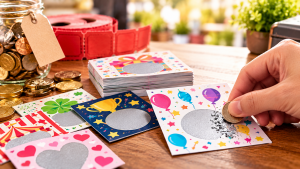
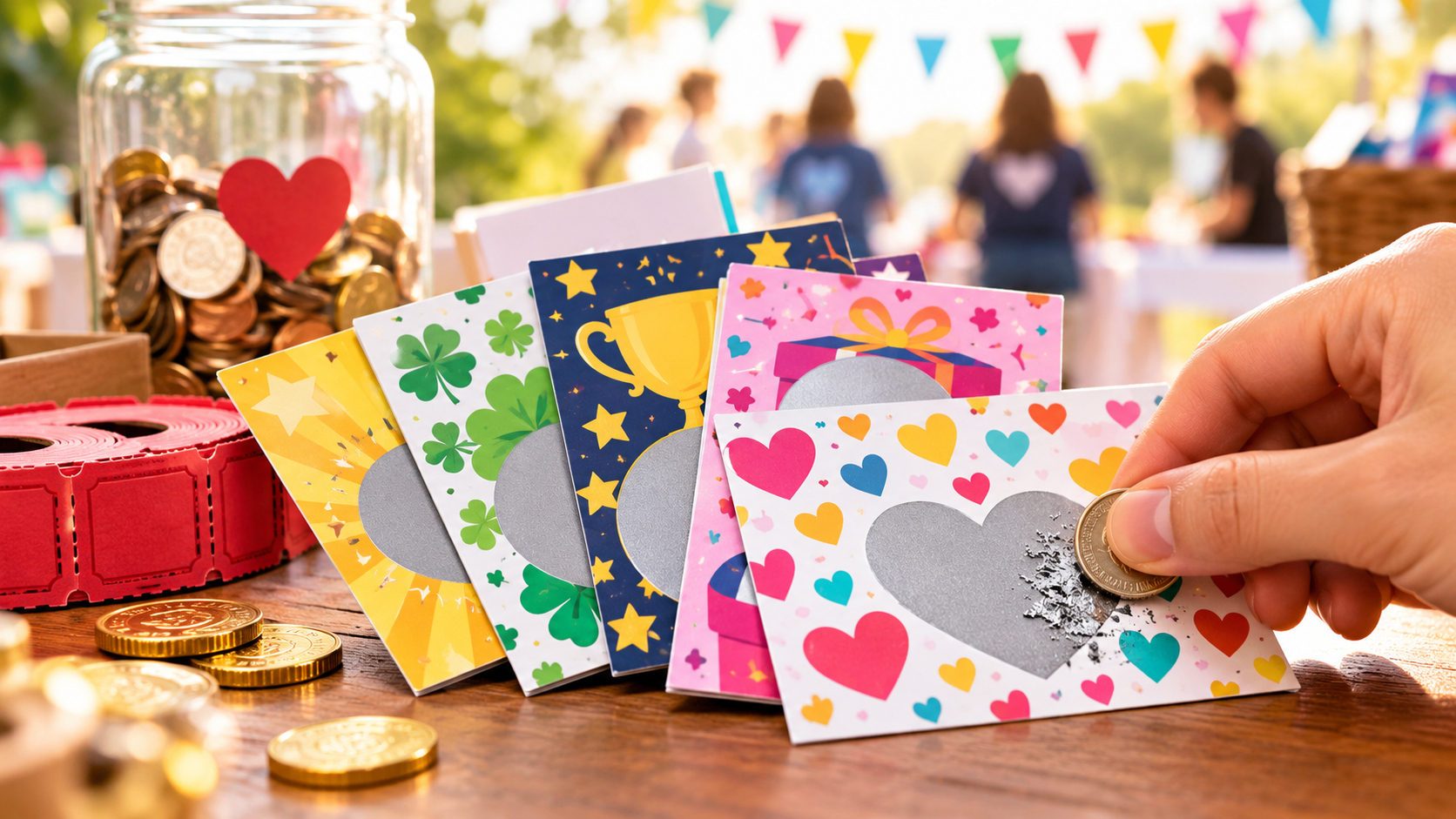
What are fundraising scratch cards? Fundraising scratch cards are donation cards covered in small scratch-off dots (usually 50–60), each hiding a dollar amount between roughly $0.50 and $3. Supporters scratch a few dots and donate the total revealed — often raising around $100 per completed card — and the organization keeps up to 90% profit because there’s no product to buy, stock, or ship. Many providers offer them with no upfront cost to the group.
If you’re researching fundraising scratch cards, you’ve almost certainly seen the big claims: “$5,000 in a weekend,” “90% profit,” “no money down.” Some of that is real. Some of it depends on fine print the provider websites skate past. This guide gives you the honest version — the real profit math, what the different card options actually cost and return, how the top providers compare, and a step-by-step for running a campaign that hits its number.
This is the buyer’s guide companion to our how-scratch-card-fundraising-works explainer — here we focus on choosing and pricing the right card for your group.
Why Fundraising Scratch Cards Beat Selling Products
Most traditional fundraisers are really retail in disguise. Your group sells cookie dough, wrapping paper, or candy bars, and keeps a thin margin — often just 30–50% — after the product company takes its cut, plus you deal with order forms, inventory, delivery, and the inevitable lost money.
Fundraising scratch cards remove the product entirely. There’s nothing to stock, nothing to ship, and nothing to deliver weeks later. That’s why the profit margin is so much higher:
| Fundraiser type | Typical profit kept |
|---|---|
| Cookie dough / catalog sales | 30–50% |
| Candy / snack sales | 40–50% |
| Discount card books | 50–60% |
| Scratch card fundraising | 80–90% |
The other advantage is speed. A product fundraiser runs for weeks because you’re collecting orders, then waiting on a shipment, then distributing it. A scratch card campaign can be done in days — a participant can fill a whole card in a single weekend of asking friends, family, and coworkers.
Why are fundraising scratch cards so profitable? Because there’s no product. Traditional fundraisers keep only 30–50% after the product company’s cut and cover inventory and shipping. Scratch card fundraising has none of those costs, so groups keep 80–90% of every dollar raised. With many providers offering the cards at no upfront cost, nearly all the money collected is pure profit for the cause.
How Much Do Fundraising Scratch Cards Raise? (Real Profit Math)
Here’s the number that matters: a single completed scratch card typically raises about $100.
The math behind it: a standard fundraising scratch card has 50–60 dots, each hiding a small amount (commonly $0.50 to $3, averaging around $2). Donors are asked to scratch two or more dots and donate the total. Scratch the whole card and you’re at roughly $100 per card.
Now scale that across a group:
| Participants | Cards completed | Approx. raised | Approx. kept (90%) |
|---|---|---|---|
| 10 | 10 | $1,000 | $900 |
| 25 | 25 | $2,500 | $2,250 |
| 50 | 50 | $5,000 | $4,500 |
| 100 | 100 | $10,000 | $9,000 |
Real reported results back this up. Groups running these campaigns have reported outcomes like $5,100 raised from 60 cards and roughly $10,000 net from a 100-member team. The numbers hold because the ask is small and specific — “scratch two dots and donate what they add up to” is far easier to say yes to than “buy a $25 tub of cookie dough.”
The donor thank-you (why people say yes)
Donors don’t walk away empty-handed. Most fundraising scratch card programs include a coupon/discount sheet — a page of local and national business offers, often advertised as $50+ in savings — handed to the donor as a thank-you. It reframes the donation as a value exchange, which lifts your yes-rate considerably.
What Do Fundraising Scratch Cards Cost the Group?
This is where fundraising scratch cards differ sharply from the custom marketing cards we price elsewhere. Many fundraising providers structure the cost as a per-card fee deducted from proceeds rather than an upfront bill — and several offer no upfront cost at all, especially for public schools and established nonprofits.
A common pricing structure looks like this:
| Cards ordered | Approx. cost per card | Profit kept |
|---|---|---|
| 10–24 | ~$20/card | ~80% |
| 25–99 | ~$15/card | ~85% |
| 100+ | ~$10/card | ~90% |
So the more participants you enroll, the lower your cost per card and the higher your margin — the same volume economics as any print product, applied to fundraising.
The “no upfront cost” model works because the provider knows a completed card raises ~$100 against a ~$10–$20 card cost. They either bill after the campaign or take their share from proceeds, so your group risks little or nothing to start.
Do fundraising scratch cards have an upfront cost? Often no. Many providers — particularly for public schools and registered nonprofits — supply the cards with no money down, billing their fee after the campaign or taking it from proceeds. For other groups, cards cost roughly $10–$20 each depending on quantity, and since each completed card raises about $100, that cost is a small fraction of what’s collected.
Types of Fundraising Scratch Cards
Not all fundraising scratch cards work the same way. Know which model you’re buying:
1. The classic donor-ask card (50–60 dots). The dominant format described above — participants carry one card and collect donations dot by dot. Best for schools, sports teams, clubs, and youth groups where you have many participants each tapping their own network.
2. Personalized/branded cards. The card carries your group’s name, logo, mascot, or a team photo. This isn’t vanity — branding materially lifts donations by adding credibility and making the ask feel legitimate rather than like a stranger’s scheme. Most reputable providers include personalization.
3. Raffle/prize scratch cards. Instead of (or alongside) donations, some campaigns sell scratch cards where donors can win actual prizes. This model needs careful attention to local raffle and gaming regulations — check your state rules before running one.
4. Custom-printed scratch cards (DIY route). If you want full control — your own prize structure, your own coupon partners, your own branding — you can order blank or custom scratch cards from a commercial printer and run the program yourself. This takes more work but can push margins even higher and lets you tailor everything to your cause. (This is where a custom scratch card printer like Just Scratch It fits — businesses and larger organizations that want a bespoke, branded scratch card program rather than an off-the-shelf fundraising kit.)
Fundraising Scratch Card Providers Compared
The “fundraising scratch cards” space has a handful of recurring names. Here’s an honest orientation (verify current terms directly — fundraising programs change pricing and inclusions often):
- Scratch & Help — one of the widely-referenced donor-card programs, built around the classic 50-dot model with coupon thank-you sheets and no-upfront-cost options for schools.
- Skratchers — another well-known program, cited in real campaign results (the ~$10,000-from-100-members figure traces to this style of program), emphasizing high participant totals.
- Big Fundraising Ideas — a broader fundraising marketplace that lists scratch card programs alongside other methods, useful for comparing against non-scratch options.
- Custom scratch card printers (e.g., Just Scratch It) — not a packaged fundraising kit, but the route for groups and businesses wanting a fully custom, branded scratch card program they design and control.
How to choose between them:
- Upfront cost / risk — can you start with no money down?
- Profit percentage — what do you actually keep after their fee?
- Personalization — is your branding included, and how good does it look?
- The coupon sheet — are the offers genuinely useful to your donors, local and current?
- Support and materials — do they provide a kickoff plan, participant instructions, and prize/incentive ideas to drive participation?
How to Run a Successful Fundraising Scratch Card Campaign
Ordering the cards is 10% of the job. Participation is the other 90%. Here’s what separates a $900 campaign from a $9,000 one:
- Enroll as many participants as you can. Revenue scales almost linearly with participant count. Ten people raise ~$1,000; a hundred raise ~$10,000. Recruiting participants is the single highest-leverage thing you can do.
- Set a clear goal and deadline. “Fill your card in two weeks” beats an open-ended ask. Urgency drives completion.
- Make the ask scriptable. Give every participant the exact words: “Scratch two dots and donate what they add up to — and here’s a coupon sheet as a thank-you.” A simple, repeatable ask dramatically lifts yes-rates.
- Add incentives. Small prizes for the first participant to fill a card, or for top fundraisers, boost completion. The gamification works on your own team, not just the donors.
- Lead with the branding. Hand out the personalized, logo’d cards — not generic ones. Credibility is what gets a neighbor or coworker to actually donate.
- Track and celebrate progress. A visible thermometer or leaderboard keeps momentum through the campaign.
How long does a fundraising scratch card campaign take? Much faster than product fundraisers — often just one to two weeks. Because there’s no order-collecting, inventory, or shipping, a motivated participant can fill an entire ~$100 card in a single weekend of asking friends, family, and coworkers. Setting a short, firm deadline (e.g., “fill your card in two weeks”) typically produces the best completion rates.
Fundraising Scratch Cards FAQ
How much can you raise with fundraising scratch cards? About $100 per completed card. A 50-participant group can raise roughly $5,000, and a 100-participant group around $10,000, keeping up to 90% as profit.
What profit percentage do groups keep? Typically 80–90% — far above the 30–50% kept on product fundraisers — because there’s no product to buy, stock, or ship.
Is there an upfront cost? Often none, especially for public schools and nonprofits. Otherwise cards run roughly $10–$20 each by quantity, a small fraction of the ~$100 each raises.
How many dots are on a fundraising scratch card? Usually 50–60 dots, each hiding about $0.50–$3. Donors are asked to scratch two or more and donate the total.
Do donors get anything in return? Yes — most programs include a coupon/discount sheet (often $50+ in local and national offers) as a thank-you, which lifts donation rates.
Who are fundraising scratch cards best for? Schools, sports teams, booster clubs, churches, youth groups, and nonprofits — any group with multiple participants who can each tap their own network.
Can businesses or large organizations run custom scratch card programs? Yes. Beyond packaged fundraising kits, custom scratch card printers let you design a fully branded program with your own prize structure and coupon partners — more work, but more control and often higher margin.
Are fundraising scratch cards legal? The standard donor-ask model is simply soliciting donations and is widely used. Raffle/prize-win models may fall under state gaming or raffle regulations — check local rules before running one.
The Bottom Line
Fundraising scratch cards are one of the highest-margin, lowest-risk, fastest fundraising methods available: about $100 raised per card, up to 90% kept, frequently no upfront cost, and a campaign that can wrap in a week or two. The two levers that decide your result are participant count (recruit aggressively) and the quality of your cards and coupon sheet (branded and genuinely useful beats generic every time).
If you want an off-the-shelf program, compare providers on upfront cost, profit percentage, and the coupon offers. If you want a fully custom, branded scratch card program — your design, your prizes, your partners — a custom printer like Just Scratch It can build it to spec.