
Categories
Uncategorized

Gender Reveal Scratch Off Cards: The Complete Guide (DIY, Costs & How to Choose)

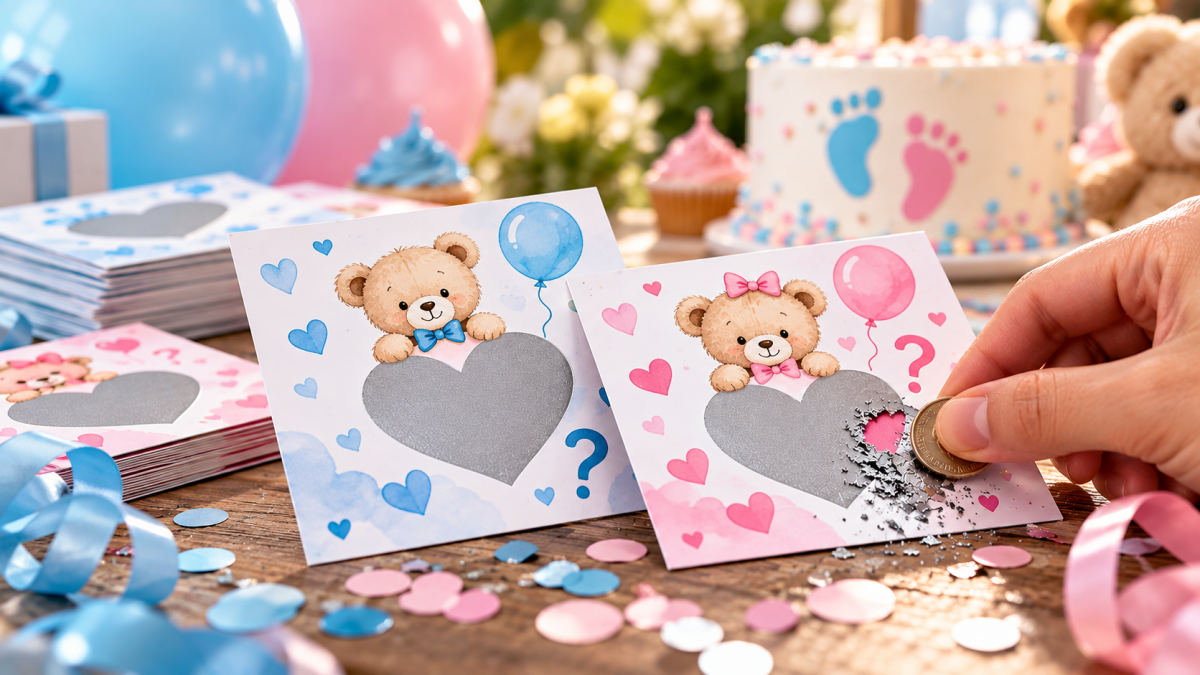
What are gender reveal scratch off cards? Gender reveal scratch off cards are announcement cards with a hidden panel concealing a baby’s sex. Recipients scratch away the coating to uncover pink/blue or “It’s a Boy!”/”It’s a Girl!” The appeal is the few seconds of suspense before the reveal — and because the cards are small and mailable, distant family can be sent one and scratch it live on a video call. You can make them yourself (about $10–$20 for a batch), buy ready-made ones ($8–$25 for a set), or order fully custom cards.

Most guides to gender reveal scratch off cards are the same listicle: “15 cute ideas,” a paint recipe, and a buy button. This one is different. It’s the decision guide — the real cost comparison between making, buying, and customizing; the logistics of pulling off a long-distance reveal that actually lands; and the small design choices that separate a card people keep forever from one that gets tossed.

If you just want the fastest path: DIY for a tiny, casual reveal; a ready-made set for a polished look without effort; custom cards for a large guest list or a keepsake you want perfect. The rest of this guide shows you how to choose and execute.


Why the Scratch-Off Reveal Works (The Psychology)

A plain announcement delivers information. A scratch card delivers an experience. The mechanic taps the same thing that makes a wrapped gift more exciting than a handed-over one: anticipation. The few seconds of scratching create a tiny suspense arc — build-up, pause, payoff — and that arc is what people remember and photograph.

It’s the same variable-reveal psychology that makes scratch cards effective in marketing and promotions — the sealed panel is almost impossible not to scratch, and the moment of uncovering is genuinely satisfying. For a gender reveal, you’re not using it to sell anything; you’re using it to turn a one-second fact into a shareable moment.

And unlike a balloon box or a cake, a scratch card travels. That single property — mailability — is why it has quietly become a favorite for families spread across cities and time zones.


DIY vs. Ready-Made vs. Custom: The Honest Comparison

This is the decision most people are actually trying to make. Here’s the straight comparison.

DIYReady-made setCustom printed
Cost~$10–$20 for a batch~$8–$25 per set (Etsy, Amazon, Target)Varies; best value at volume
EffortHigh (paint, dry, repeat)NoneLow (you supply details)
LookCharming but inconsistentPolished, templatedFully personalized, professional
Lead timeSame day1–5 days shipping (or instant printable)Production + shipping
Best forA few casual cardsMost revealsLarge lists, keepsakes, themed events

DIY: cheapest, most personal

The homemade method is genuinely easy. Print or write your reveal (“It’s a Girl!” / “It’s a Boy!”) on cardstock, cover it with a strip of clear packing tape, then paint over the tape with a 2:1 mix of metallic acrylic paint and dish soap. The dish soap is the trick — it keeps the paint scratchable once dry. Let it dry fully, and you’ve got a scratch panel.

  • Materials: cardstock, metallic acrylic paint, dish soap, clear packing tape — roughly $10–$20 for a batch of cards.
  • Watch out for: inconsistent coverage (thin spots show the answer), and drying time if you’re making many.
  • Shortcut: peel-and-stick scratch-off sticker labels (about $6–$10 for 100+) let you skip the paint entirely — just write under the sticker.

Ready-made: the default choice

For most people, a ready-made set is the sweet spot — no effort, a polished look, and cheap. You’ll find them on Etsy (designer/customizable), Amazon (fast, bulk sets), and Target (grab-and-go). Expect $8–$25 per set depending on count and design. Many Etsy sellers offer instant-download printables if you don’t want to wait on shipping.

Custom: for scale and keepsakes

If you’re sending to a big guest list, want your names/photo/due date on the card, or want a genuine keepsake, custom printing is the move. It’s also the right call if you’re building a themed reveal event and want the cards to match your invitations and décor. A custom scratch card printer like Just Scratch It can produce personalized, professional cards — the same printing used for marketing promotions, applied to your announcement.


12 Ways to Use Gender Reveal Scratch Off Cards

The card is the medium; the reveal is the moment. Here are the formats that work best:

  1. The simultaneous scratch. Hand cards to everyone at a gathering and have them scratch on “three, two, one.” A room full of reactions at once — the most photographed version.
  2. The long-distance video reveal. Mail cards ahead to distant family, then get everyone on a video call and scratch together live. (Full logistics below — this is the one people get wrong.)
  3. The grandparents-first reveal. Give the grandparents their cards before anyone else, as a special moment for them.
  4. The tic-tac-toe card. A multi-panel card where scratching three in a row reveals the answer — stretches the suspense.
  5. The “you find out when we do” card. Hand your partner a card at the ultrasound follow-up so you discover it together.
  6. The sibling announcement. Let an older child scratch to learn they’re getting a brother or sister.
  7. The mailed save-the-scratch. Combine the reveal with a baby shower invite — one card does both jobs.
  8. The workplace reveal. Low-key way to tell colleagues without a whole event.
  9. The photo-reveal card. A custom card with your ultrasound photo or names, so it doubles as a keepsake.
  10. The “guess first” game. Everyone writes their guess, then scratches — turns it into a party game.
  11. The delayed reveal. Scratch cards you mail with “don’t scratch until [date/time]” so everyone reveals in sync across locations.
  12. The keepsake card. A single beautifully custom card you scratch and then frame.

The Long-Distance Video Reveal (Done Right)

This is the use case that makes scratch cards special — and the one most guides gloss over. Getting it right takes a little planning:

  1. Mail early. Send cards with enough buffer that everyone has theirs before the call — the slowest piece of mail sets your date. Build in a week.
  2. Seal the surprise from yourself too (optional). If you want to find out live with everyone, have the ultrasound tech or a trusted friend prepare the cards so even you don’t know.
  3. Add a “don’t scratch yet” instruction. A sticker or note on the envelope keeps eager relatives from peeking early.
  4. Pick a time that works across time zones. Coordinate so grandparents three zones away aren’t scratching at midnight.
  5. Do a countdown. On the call, everyone holds their card up, counts down, and scratches together. The synchronized gasp is the whole point.
  6. Record it. Have someone screen-record the call — this is the footage you’ll keep.

Can you do a gender reveal by mail with scratch off cards? Yes — it’s one of their biggest advantages. Mail a scratch card to each distant family member ahead of time with a “don’t scratch yet” note, then gather everyone on a video call and scratch together on a countdown. Because the cards are small, flat, and sealed, they mail easily and keep the surprise intact until the shared moment. Build in about a week so the slowest-arriving card still lands before the call.


Gender reveals themselves are a relatively recent phenomenon — the trend took off in the 2010s and exploded with social media, where the reaction became as important as the news. That shift is exactly why scratch cards fit the moment: they manufacture a reaction worth filming.

Two forces are pushing scratch cards specifically:

  • The backlash against big, risky reveals. After several widely-reported incidents involving pyrotechnic and explosive reveals, many expecting parents are deliberately choosing small, safe, intimate reveals. A scratch card is about as safe and low-key as it gets.
  • Distributed families. With relatives increasingly spread across the country, the mail-and-video-call reveal has become a practical necessity — and scratch cards are purpose-built for it.

The result: a move away from spectacle and toward personal, shareable, keepsake-able moments. Scratch cards sit right in that sweet spot.


Design Tips for a Card People Keep

Small choices make a big difference:

  • Make the reveal legible. “It’s a Girl!” in a clean, large font reads better in photos than tiny script.
  • Mind the scratch coverage. Whether DIY or ordered, the panel must fully hide the answer — a thin spot ruins the surprise. Test one card before you commit the batch.
  • Match your palette. If you’re doing an event, coordinate the card with your invites and décor.
  • Add a keepsake element. Names, due date, or an ultrasound image turn a disposable card into something people frame.
  • Include the instruction. A simple “Scratch to reveal!” removes any confusion about what to do.

Gender Reveal Scratch Off Cards FAQ

How do gender reveal scratch off cards work? A hidden panel covers the reveal (“Boy!”/”Girl!” or pink/blue). The recipient scratches off the coating to uncover it — a few seconds of suspense before the news.

How much do gender reveal scratch off cards cost? DIY runs about $10–$20 for a batch; ready-made sets are $8–$25 (Etsy, Amazon, Target); custom printed cards vary and are best value at volume.

How do you make gender reveal scratch off cards yourself? Write the reveal on cardstock, cover it with clear packing tape, and paint over the tape with a 2:1 mix of metallic acrylic paint and dish soap. Let it dry fully — the dish soap keeps it scratchable.

Can you mail gender reveal scratch off cards? Yes — they’re small, flat, and sealed, which is their biggest advantage. Mail them to distant family and reveal together on a video call.

Where can I buy gender reveal scratch off cards? Etsy (customizable/printable), Amazon (fast, bulk), and Target (in-store) for ready-made sets; a custom scratch card printer for personalized or large-volume orders.

What’s the best option for a big guest list? Custom printed cards — consistent quality, personalization, and better per-card value at volume than buying many small sets.

How far ahead should I mail them for a long-distance reveal? About a week, so even the slowest-arriving card lands before your scheduled video call. Add a “don’t scratch yet” note to protect the surprise.

Do I have to know the gender to make them? No — have the ultrasound tech or a trusted friend prepare the cards so you can find out live with everyone else.


The Bottom Line

Gender reveal scratch off cards win because they turn a one-second fact into a shareable, keepsake-able moment — and because they travel, letting far-flung family join a synchronized reveal by mail and video call. Choose DIY for a small, casual, budget reveal; a ready-made set for a polished look with zero effort; and custom printing for a big list, a themed event, or a card you’ll frame.

Whichever route you pick, the two things that make or break it are full scratch coverage (test one first) and a legible, photogenic reveal. Get those right and you’ve got a moment worth keeping.

For a personalized or large-volume order, Just Scratch It produces custom scratch off cards to spec — the same professional printing behind marketing promotions, made into your announcement.
Categories
Uncategorized

How Much Do Scratch Offs Cost? The 2026 Price Guide (With Real Numbers)

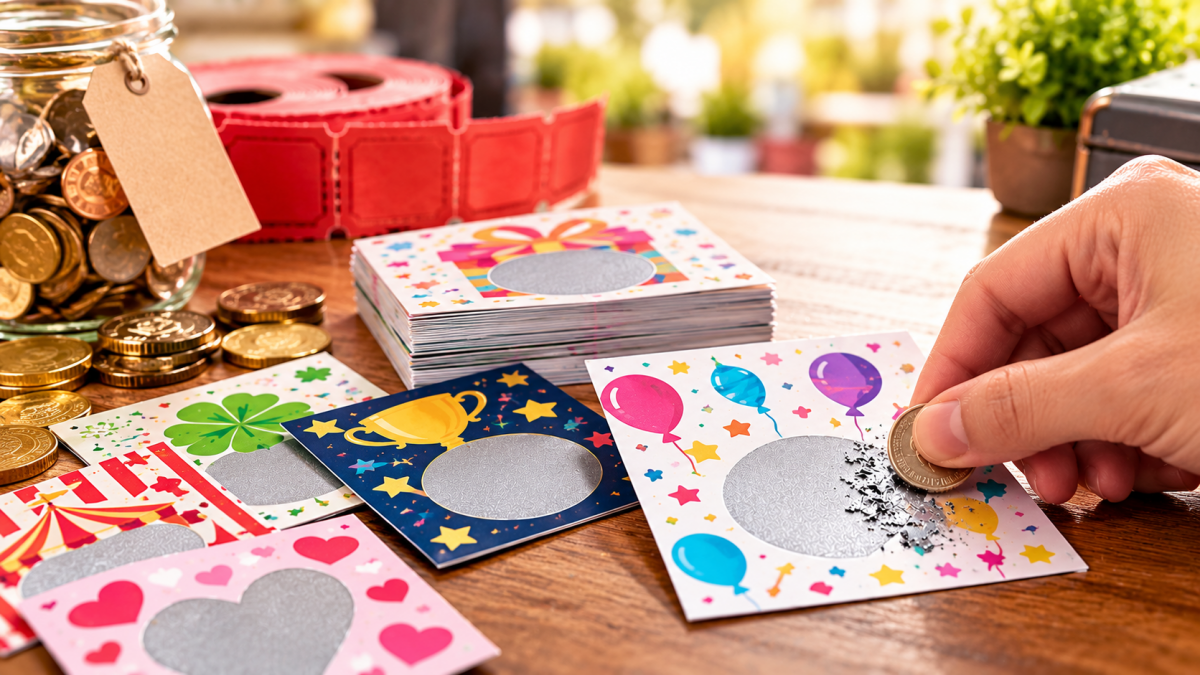
How much do scratch offs cost? Custom scratch off cards typically cost between $0.12 and $2.37 per card, depending almost entirely on quantity. Small runs of 100 cards run roughly $2.00–$2.95 each ($175–$295 total), while orders of 10,000+ drop to around $0.12–$0.15 per card. At Just Scratch It, custom cards start near 12¢ per card at 10,000 units with design included. A DIY batch of 50 cards costs about $10–$20 in materials.

If you’ve searched “how much do scratch offs cost,” you’ve probably noticed something frustrating: almost nobody gives you a straight number. The lottery pages talk about $1, $2, $5, $10, $20, and $30 state lottery tickets. The printing companies hide pricing behind a “request a quote” button. And the DIY tutorials wave their hands at “a few bucks.”

This guide fixes that. Below you’ll find real per-card pricing pulled from live vendor price tables, a full breakdown of every factor that moves the price up or down, the actual math on DIY vs. professional printing, and the data on what scratch off cards return when used for marketing — because “how much do they cost” and “are they worth it” are really the same question.


Quick Answer: Scratch Off Pricing at a Glance

There are two completely different products people mean by “scratch offs,” so let’s separate them first.

What you meanTypical costWho buys it
State lottery scratch tickets$1 – $30 per ticket (face value)Consumers playing the lottery
Custom scratch off cards (marketing, promos, fundraising, events)$0.12 – $2.37 per cardBusinesses, schools, event hosts

This article is about the second category — custom printed scratch off cards you order for a promotion, a direct mail campaign, an event, a fundraiser, or a giveaway. (If you landed here looking for lottery odds, you want your state lottery’s website, not a printer.)

For custom cards, the single biggest driver of price is how many you order. Everything else — size, finish, design, personalization — matters, but quantity is the lever that moves cost from nearly $2.40 a card down to pennies.


How Much Do Custom Scratch Off Cards Cost by Quantity?

Here’s the part the quote-gated printers don’t want you to see on the first click. The table below reflects real published per-card pricing for a standard business-card-size scratch off card (full color, one scratch panel), aggregated from live online print vendors in 2026:

QuantityApprox. price per cardApprox. total
100$2.37$237
300$1.14$342
500$0.84$420
1,000$0.55$550
2,000$0.40$800
4,000$0.25$1,000
6,000$0.19$1,140
10,000$0.15$1,500
25,000+$0.12 or lower$3,000+

The pattern is unmistakable: the per-card price falls by roughly 94% from a 100-card order to a 25,000-card order. Scratch off printing is dominated by setup costs — plates, color calibration, the scratch-coating pass, die-cutting — and those are fixed no matter how many cards you run. Spread across 100 cards, setup is brutal. Spread across 10,000, it nearly disappears.

Why do small scratch off orders cost so much per card? Scratch off printing carries high fixed setup costs — printing plates, scratch-coating application, die-cutting, and color calibration — that don’t change whether you print 100 cards or 10,000. On a 100-card run those costs are divided across only 100 cards, so each one absorbs a big share. On large runs, setup is spread thin and the per-card price collapses toward $0.12–$0.15.

What this means for your budget

  • Need fewer than 250 cards? Expect to pay $1–$2.50 each. Honestly, at this volume, DIY (covered below) is often the smarter move unless you need a polished, branded look.
  • Ordering 500–2,000? This is the sweet spot for most small-business promotions and events. You’re paying $0.40–$0.85 per card and getting professional print quality.
  • Running a direct mail or large retail campaign (5,000+)? You’re now in $0.12–$0.20 territory, which is where scratch cards become one of the cheapest high-engagement marketing assets you can buy.

Why Do Scratch Off Cards Cost More Than Regular Printed Cards?

A standard full-color business card at 1,000 units might cost you 3–8 cents each. A scratch off card at the same quantity runs 50+ cents. Where does the extra money go?

  1. The scratch coating itself. That silver or gold panel is a separate layer — usually a latex-based or metallic opaque ink — applied in its own press pass or by a dedicated scratch-off machine. It’s an extra material and an extra production step.
  2. The hidden layer. Before the scratch coating goes on, your variable prize/code/message is printed underneath. If every card is identical, that’s cheap. If every card is different (unique codes, personalized names), that requires variable data printing (VDP) — more on that below.
  3. Security printing. Legitimate promotional scratch cards use “confusion printing” — random symbols or patterns printed under the coating around the real prize — so winners can’t be detected by holding the card to light. This adds design and press complexity.
  4. Thicker stock. Scratch cards are usually printed on heavier card stock (so the scratch action doesn’t tear through) and often laminated, which costs more than standard paper.
  5. Die-cutting and finishing. Custom shapes, rounded corners, perforations, and folding all add finishing passes.

So the premium isn’t a markup — it’s a genuinely more complex product.


The 10 Factors That Change Your Scratch Off Price

Beyond quantity, here’s everything that moves your quote up or down. Use this as a checklist when comparing vendors so you’re comparing apples to apples.

1. Quantity. Already covered — by far the biggest factor. Always ask for pricing at the next tier up; the jump is often tiny relative to how many more cards you get.

2. Card size. A standard business-card size (3.5″ × 2″) is cheapest because it nests efficiently on a press sheet. Postcard sizes (for direct mail) and oversized cards cost more per unit.

3. Scratch panel size and count. One small panel is standard. Multiple panels (think a tic-tac-toe or match-3 game) or a full-card scratch coating use more material and cost more.

4. Color. Full-color (CMYK) both sides is the norm now and priced accordingly. One-color or black-only can shave cost on very large runs.

5. Variable data / personalization. Printing a unique code, serial number, or recipient’s name on every card requires VDP. This is where a lot of the value is for marketing (trackable codes, “You’re a winner” mechanics), but it adds cost — typically a per-record or setup fee.

6. Prize structure and odds design. If you want a managed “everyone wins” structure (e.g., 70% small prize / 25% mid / 5% grand), properly randomized and confusion-printed, that’s a design/consulting layer some vendors include and others charge for.

7. Stock and thickness. Heavier stock, premium matte or gloss, recycled stock — each nudges price.

8. Finish and extras. Lamination, foil, spot UV, rounded corners, perforation, folding (for mailers).

9. Design services. Supplying print-ready artwork is cheapest. If the vendor designs the card for you, expect a design fee — though some, including Just Scratch It, include design in the per-card price, which materially changes the real cost comparison.

10. Turnaround and shipping. Standard production is baked into the quote. Rush jobs cost a premium. Shipping on heavy card stock in volume is a real line item — always get it quoted before you commit.

What’s the single best way to lower scratch off card cost? Order in the largest quantity you can realistically use. Because setup costs are fixed, moving from 500 cards to 1,000 often costs far less than double — sometimes only 30–40% more for twice the cards. The second-best lever is supplying your own print-ready design to avoid design fees, and the third is choosing a standard size and a single scratch panel.


DIY vs. Professional: The Real Cost Math

A huge share of “how much do scratch offs cost” searches come from people planning a small, personal run — a gender reveal, a date-night card, a small classroom reward, a wedding save-the-date. For these, DIY is genuinely viable. Here’s the honest comparison.

DIY scratch off cost

The homemade method: print or write your message on cardstock, cover it with clear packing tape, then paint over the tape with a 2:1 mix of metallic acrylic paint and dish soap (the dish soap lets it scratch off later).

DIY componentApprox. cost
Cardstock (50+ sheets)$5–$8
Metallic acrylic paint$4–$7
Dish soapAlready in your kitchen
Clear packing tape$3–$5
Scratch-off sticker labels (shortcut option)$6–$10 for 100+
Total for ~50 cards$10–$20

That’s roughly $0.20–$0.40 per card in materials — but it costs you time, the finish is inconsistent, and it won’t look professional or carry secure confusion printing. Perfect for a reveal or a party; wrong for a brand campaign.

Professional printing cost (same 50 cards)

At 50–100 units, professional printing runs $2.00–$2.95 per card, so your 50-card order lands around $100–$150. You’re paying for consistency, a branded look, durable stock, and (if needed) unique codes and secure printing.

The crossover

  • Personal, one-off, fewer than ~100 cards, look doesn’t need to be perfect → DIY wins on cost.
  • Any business use, any branded look, any need for unique codes or scale → professional wins the moment you factor in your time and the credibility a cheap-looking card costs you.

How to Get the Lowest Price on Scratch Off Cards

Five concrete moves, in order of impact:

  1. Size the order to the next tier. Before you order 800, price 1,000. The marginal cards are nearly free compared to the setup you’ve already paid for.
  2. Supply print-ready artwork (or pick a vendor that includes design, so it’s a wash).
  3. Stick to a standard size and one scratch panel unless the game mechanic genuinely needs more.
  4. Bundle campaigns. If you run quarterly promotions, print the year’s cards in one run and store them. One setup, four campaigns.
  5. Get an all-in quote. Insist that design, data/personalization, and shipping are in the number. A low per-card price with surprise fees on top is the oldest trick in print.

What Do You Actually Get for the Price? (The ROI Case)

Here’s why businesses happily pay 15¢–55¢ a card: scratch cards get interacted with at rates almost nothing else in marketing can match.

  • Scratch off cards see response/redemption rates commonly cited in the 30–50% range for well-run promotions — a figure driven by the simple fact that a sealed panel is almost impossible not to scratch.
  • According to the Association of National Advertisers (ANA) / DMA Response Rate Report, direct mail achieves around a 4.4% response rate, versus roughly 0.12% for email — and adding a tactile, interactive element like a scratch panel is a well-documented way to push mail response higher still.
  • The psychology is variable-reward gamification: the same mechanic that makes slot machines and loot boxes compelling makes a scratch panel irresistible. You’re not selling the prize; you’re selling the scratch.

Run the math on a 5,000-card direct mail drop at ~$0.19/card: that’s about $950 in cards. If even a conservative slice of recipients scratch and redeem, the cost-per-engaged-customer is a rounding error next to most paid digital channels. That’s the real answer to “are they worth it” — and it’s why the cost question matters less than it first appears.

Are scratch off cards expensive for marketing? No — they’re among the cheapest high-engagement tools available. At scale, custom scratch cards cost roughly $0.12–$0.20 each, while driving redemption rates far above email or standard mail. A 5,000-card campaign costs under $1,000 in cards, and because a sealed scratch panel is almost always scratched, the cost per engaged recipient is extremely low compared to digital advertising.


Scratch Off Cost FAQ

How much do scratch off cards cost per card? Custom scratch off cards cost about $0.12–$2.37 each. Small runs (100 cards) are ~$2.37/card; large runs (10,000+) drop to ~$0.12–$0.15/card because fixed setup costs spread across more units.

How much does it cost to print 1,000 scratch off cards? Roughly $0.55 per card, or about $550 total for a standard full-color, single-panel business-card-size run — before any design, personalization, or shipping extras.

How much do scratch offs cost to make yourself (DIY)? About $10–$20 in materials for ~50 cards (cardstock, metallic acrylic paint, dish soap, clear tape), or roughly $0.20–$0.40 per card — plus your time, with a less polished result.

Why are custom scratch cards more expensive than regular cards? Because of the extra scratch-coating layer, a hidden printed layer underneath, security “confusion printing,” heavier stock, and die-cutting — all production steps a plain printed card doesn’t need.

Does personalization raise the cost? Yes. Printing a unique code or name on every card requires variable data printing (VDP), which adds a setup or per-record fee — but it’s what makes cards trackable and enables “winner” mechanics.

What’s the cheapest quantity to order? Per card, the more you order the cheaper it gets. Per order, 100 is the smallest typical minimum. If you need under 100 and don’t need a branded look, DIY is cheaper.

How much do design fees add? It varies — some vendors charge a separate design fee, others (including Just Scratch It) include design in the per-card price, which can make a slightly higher sticker price the cheaper all-in deal.

Do scratch off cards have minimum orders? Most professional printers set minimums around 100–250 cards. Below that, you’re usually better off with DIY or sticker labels.

How much should I budget for a scratch off marketing campaign? For a solid mid-size campaign, budget around $500–$1,500 for the cards themselves (1,000–6,000 units), plus design (if not included) and shipping. The engagement rates typically justify the spend.

Are scratch off cards worth the cost? For engagement, yes — redemption rates of 30–50% and direct-mail response well above email make the per-card cost easy to justify, especially at volume where cards cost pennies.


The Bottom Line

How much do scratch offs cost? Between 12¢ and about $2.37 per custom card, with quantity as the dominant lever. Small personal runs favor DIY at $10–$20 for a batch; business and marketing runs favor professional printing, which gets dramatically cheaper the more you order and delivers engagement rates most channels can’t touch.

If you’re pricing cards for a promotion, event, fundraiser, or direct mail campaign, the smart move is to get an all-in quote (design, personalization, and shipping included) at the quantity you actually need — and to price the next tier up before you commit, because the extra cards are almost always nearly free.

Just Scratch It builds custom scratch off cards for businesses with design included and per-card pricing that starts near 12¢ at volume — so you can see your real, all-in cost up front instead of chasing a quote.

Categories
Uncategorized

Fundraising Scratch Cards: The Complete Buyer’s Guide (Costs, Profit & How to Choose)

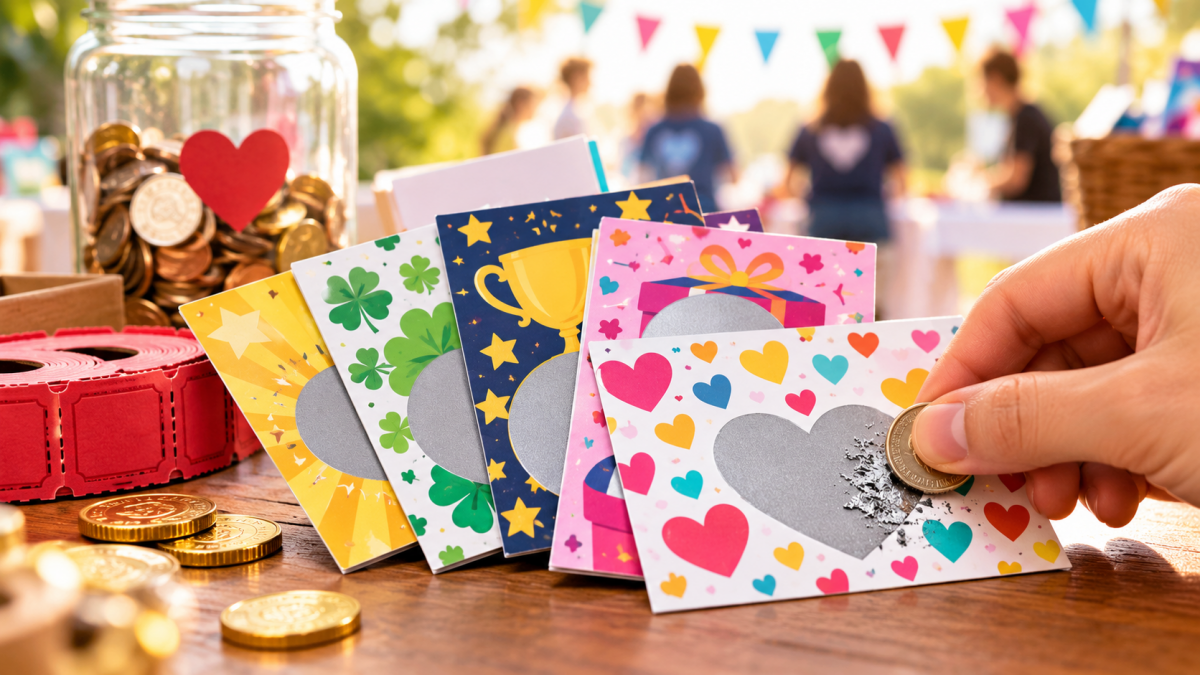
What are fundraising scratch cards? Fundraising scratch cards are donation cards covered in small scratch-off dots (usually 50–60), each hiding a dollar amount between roughly $0.50 and $3. Supporters scratch a few dots and donate the total revealed — often raising around $100 per completed card — and the organization keeps up to 90% profit because there’s no product to buy, stock, or ship. Many providers offer them with no upfront cost to the group.

If you’re researching fundraising scratch cards, you’ve almost certainly seen the big claims: “$5,000 in a weekend,” “90% profit,” “no money down.” Some of that is real. Some of it depends on fine print the provider websites skate past. This guide gives you the honest version — the real profit math, what the different card options actually cost and return, how the top providers compare, and a step-by-step for running a campaign that hits its number.

This is the buyer’s guide companion to our how-scratch-card-fundraising-works explainer — here we focus on choosing and pricing the right card for your group.


Why Fundraising Scratch Cards Beat Selling Products

Most traditional fundraisers are really retail in disguise. Your group sells cookie dough, wrapping paper, or candy bars, and keeps a thin margin — often just 30–50% — after the product company takes its cut, plus you deal with order forms, inventory, delivery, and the inevitable lost money.

Fundraising scratch cards remove the product entirely. There’s nothing to stock, nothing to ship, and nothing to deliver weeks later. That’s why the profit margin is so much higher:

Fundraiser typeTypical profit kept
Cookie dough / catalog sales30–50%
Candy / snack sales40–50%
Discount card books50–60%
Scratch card fundraising80–90%

The other advantage is speed. A product fundraiser runs for weeks because you’re collecting orders, then waiting on a shipment, then distributing it. A scratch card campaign can be done in days — a participant can fill a whole card in a single weekend of asking friends, family, and coworkers.

Why are fundraising scratch cards so profitable? Because there’s no product. Traditional fundraisers keep only 30–50% after the product company’s cut and cover inventory and shipping. Scratch card fundraising has none of those costs, so groups keep 80–90% of every dollar raised. With many providers offering the cards at no upfront cost, nearly all the money collected is pure profit for the cause.


How Much Do Fundraising Scratch Cards Raise? (Real Profit Math)

Here’s the number that matters: a single completed scratch card typically raises about $100.

The math behind it: a standard fundraising scratch card has 50–60 dots, each hiding a small amount (commonly $0.50 to $3, averaging around $2). Donors are asked to scratch two or more dots and donate the total. Scratch the whole card and you’re at roughly $100 per card.

Now scale that across a group:

ParticipantsCards completedApprox. raisedApprox. kept (90%)
1010$1,000$900
2525$2,500$2,250
5050$5,000$4,500
100100$10,000$9,000

Real reported results back this up. Groups running these campaigns have reported outcomes like $5,100 raised from 60 cards and roughly $10,000 net from a 100-member team. The numbers hold because the ask is small and specific — “scratch two dots and donate what they add up to” is far easier to say yes to than “buy a $25 tub of cookie dough.”

The donor thank-you (why people say yes)

Donors don’t walk away empty-handed. Most fundraising scratch card programs include a coupon/discount sheet — a page of local and national business offers, often advertised as $50+ in savings — handed to the donor as a thank-you. It reframes the donation as a value exchange, which lifts your yes-rate considerably.


What Do Fundraising Scratch Cards Cost the Group?

This is where fundraising scratch cards differ sharply from the custom marketing cards we price elsewhere. Many fundraising providers structure the cost as a per-card fee deducted from proceeds rather than an upfront bill — and several offer no upfront cost at all, especially for public schools and established nonprofits.

A common pricing structure looks like this:

Cards orderedApprox. cost per cardProfit kept
10–24~$20/card~80%
25–99~$15/card~85%
100+~$10/card~90%

So the more participants you enroll, the lower your cost per card and the higher your margin — the same volume economics as any print product, applied to fundraising.

The “no upfront cost” model works because the provider knows a completed card raises ~$100 against a ~$10–$20 card cost. They either bill after the campaign or take their share from proceeds, so your group risks little or nothing to start.

Do fundraising scratch cards have an upfront cost? Often no. Many providers — particularly for public schools and registered nonprofits — supply the cards with no money down, billing their fee after the campaign or taking it from proceeds. For other groups, cards cost roughly $10–$20 each depending on quantity, and since each completed card raises about $100, that cost is a small fraction of what’s collected.


Types of Fundraising Scratch Cards

Not all fundraising scratch cards work the same way. Know which model you’re buying:

1. The classic donor-ask card (50–60 dots). The dominant format described above — participants carry one card and collect donations dot by dot. Best for schools, sports teams, clubs, and youth groups where you have many participants each tapping their own network.

2. Personalized/branded cards. The card carries your group’s name, logo, mascot, or a team photo. This isn’t vanity — branding materially lifts donations by adding credibility and making the ask feel legitimate rather than like a stranger’s scheme. Most reputable providers include personalization.

3. Raffle/prize scratch cards. Instead of (or alongside) donations, some campaigns sell scratch cards where donors can win actual prizes. This model needs careful attention to local raffle and gaming regulations — check your state rules before running one.

4. Custom-printed scratch cards (DIY route). If you want full control — your own prize structure, your own coupon partners, your own branding — you can order blank or custom scratch cards from a commercial printer and run the program yourself. This takes more work but can push margins even higher and lets you tailor everything to your cause. (This is where a custom scratch card printer like Just Scratch It fits — businesses and larger organizations that want a bespoke, branded scratch card program rather than an off-the-shelf fundraising kit.)


Fundraising Scratch Card Providers Compared

The “fundraising scratch cards” space has a handful of recurring names. Here’s an honest orientation (verify current terms directly — fundraising programs change pricing and inclusions often):

  • Scratch & Help — one of the widely-referenced donor-card programs, built around the classic 50-dot model with coupon thank-you sheets and no-upfront-cost options for schools.
  • Skratchers — another well-known program, cited in real campaign results (the ~$10,000-from-100-members figure traces to this style of program), emphasizing high participant totals.
  • Big Fundraising Ideas — a broader fundraising marketplace that lists scratch card programs alongside other methods, useful for comparing against non-scratch options.
  • Custom scratch card printers (e.g., Just Scratch It) — not a packaged fundraising kit, but the route for groups and businesses wanting a fully custom, branded scratch card program they design and control.

How to choose between them:

  1. Upfront cost / risk — can you start with no money down?
  2. Profit percentage — what do you actually keep after their fee?
  3. Personalization — is your branding included, and how good does it look?
  4. The coupon sheet — are the offers genuinely useful to your donors, local and current?
  5. Support and materials — do they provide a kickoff plan, participant instructions, and prize/incentive ideas to drive participation?

How to Run a Successful Fundraising Scratch Card Campaign

Ordering the cards is 10% of the job. Participation is the other 90%. Here’s what separates a $900 campaign from a $9,000 one:

  1. Enroll as many participants as you can. Revenue scales almost linearly with participant count. Ten people raise ~$1,000; a hundred raise ~$10,000. Recruiting participants is the single highest-leverage thing you can do.
  2. Set a clear goal and deadline. “Fill your card in two weeks” beats an open-ended ask. Urgency drives completion.
  3. Make the ask scriptable. Give every participant the exact words: “Scratch two dots and donate what they add up to — and here’s a coupon sheet as a thank-you.” A simple, repeatable ask dramatically lifts yes-rates.
  4. Add incentives. Small prizes for the first participant to fill a card, or for top fundraisers, boost completion. The gamification works on your own team, not just the donors.
  5. Lead with the branding. Hand out the personalized, logo’d cards — not generic ones. Credibility is what gets a neighbor or coworker to actually donate.
  6. Track and celebrate progress. A visible thermometer or leaderboard keeps momentum through the campaign.

How long does a fundraising scratch card campaign take? Much faster than product fundraisers — often just one to two weeks. Because there’s no order-collecting, inventory, or shipping, a motivated participant can fill an entire ~$100 card in a single weekend of asking friends, family, and coworkers. Setting a short, firm deadline (e.g., “fill your card in two weeks”) typically produces the best completion rates.


Fundraising Scratch Cards FAQ

How much can you raise with fundraising scratch cards? About $100 per completed card. A 50-participant group can raise roughly $5,000, and a 100-participant group around $10,000, keeping up to 90% as profit.

What profit percentage do groups keep? Typically 80–90% — far above the 30–50% kept on product fundraisers — because there’s no product to buy, stock, or ship.

Is there an upfront cost? Often none, especially for public schools and nonprofits. Otherwise cards run roughly $10–$20 each by quantity, a small fraction of the ~$100 each raises.

How many dots are on a fundraising scratch card? Usually 50–60 dots, each hiding about $0.50–$3. Donors are asked to scratch two or more and donate the total.

Do donors get anything in return? Yes — most programs include a coupon/discount sheet (often $50+ in local and national offers) as a thank-you, which lifts donation rates.

Who are fundraising scratch cards best for? Schools, sports teams, booster clubs, churches, youth groups, and nonprofits — any group with multiple participants who can each tap their own network.

Can businesses or large organizations run custom scratch card programs? Yes. Beyond packaged fundraising kits, custom scratch card printers let you design a fully branded program with your own prize structure and coupon partners — more work, but more control and often higher margin.

Are fundraising scratch cards legal? The standard donor-ask model is simply soliciting donations and is widely used. Raffle/prize-win models may fall under state gaming or raffle regulations — check local rules before running one.


The Bottom Line

Fundraising scratch cards are one of the highest-margin, lowest-risk, fastest fundraising methods available: about $100 raised per card, up to 90% kept, frequently no upfront cost, and a campaign that can wrap in a week or two. The two levers that decide your result are participant count (recruit aggressively) and the quality of your cards and coupon sheet (branded and genuinely useful beats generic every time).

If you want an off-the-shelf program, compare providers on upfront cost, profit percentage, and the coupon offers. If you want a fully custom, branded scratch card program — your design, your prizes, your partners — a custom printer like Just Scratch It can build it to spec.

You Have Subscribed Succesfully

You might now close this window