Categories
Uncategorized

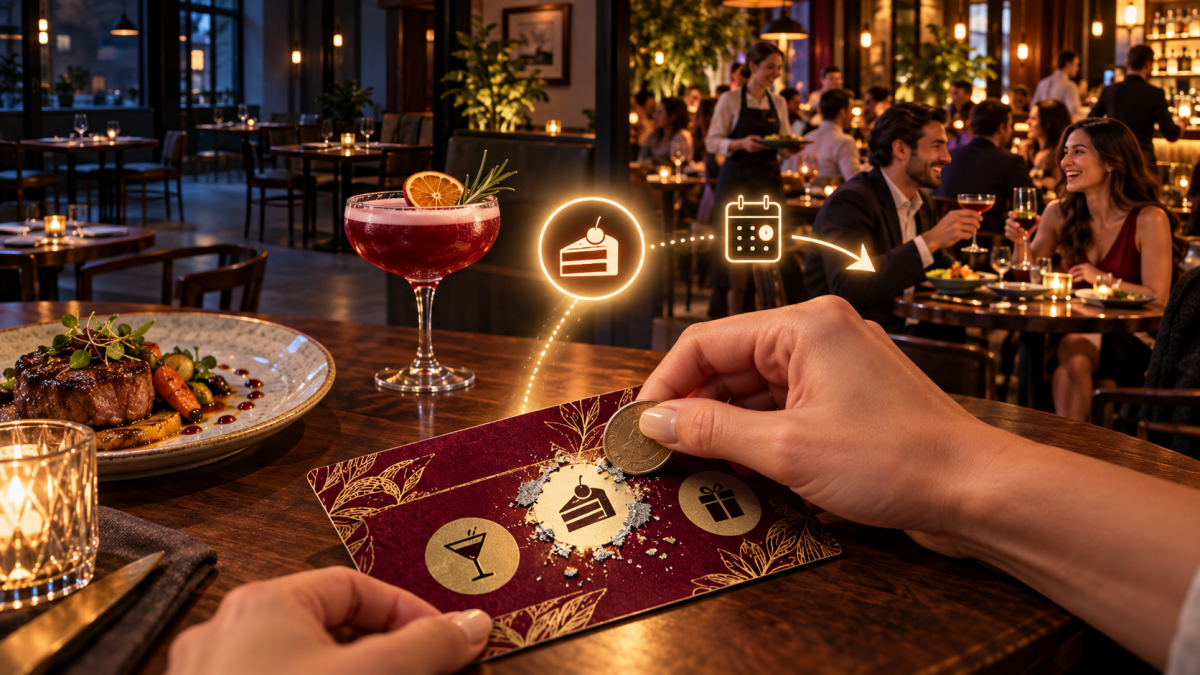
Scratch Off Cards for Restaurants & Bars: Fill Slow Shifts and Drive Repeat Visits 

Restaurants and bars live and die by two numbers: how often customers come back, and how full the room is on a slow Tuesday. Scratch off cards move both. By turning a check drop, a happy-hour round, or a mailer into a “scratch to see what you won” moment, they give customers a concrete reason to return — and they work, because almost nobody can resist scratching a card.

This guide is built for restaurant and bar operators who are ready to run a scratch-off promotion and want to know exactly how their industry uses them. It covers the proven campaign ideas, prize structures, real results, and how to launch one that drives measurable revenue.

Quick answer: How do restaurants use scratch off cards? Restaurants use scratch off cards to drive repeat visits, fill slow shifts, and increase check sizes. The most effective tactics are handing out “come back and scratch” cards when tables are full (redeemed on a return visit), loyalty cards scratched after a set number of visits, mystery-discount mailers, and happy-hour or game-day scratch-offs at bars. Every card wins something, so customers always have a reason to return.


Why Scratch Off Cards Work So Well for Restaurants

The restaurant industry is brutally competitive, and standing out matters. Scratch off cards give operators an edge for three reasons:

  • They guarantee engagement. The reveal compels customers to interact with your restaurant beyond the meal — almost nobody discards a scratch card unscratched, so your offer always gets seen.
  • They drive repeat visits. A card redeemed on a return trip manufactures a concrete reason to come back, which is exactly what turns a one-time diner into a regular.
  • They deliver real ROI. Interactive promotions like scratch cards generate 30–50% higher response rates than plain coupons or standard direct mail. One seaside restaurant used a scratch-off promotion to fill tables after tourist season and reported an ROI of 1,931%.

The results can be dramatic. When Moe’s Southwest Grill ran a football-season scratch-off promotion through Just Scratch It, sales climbed 22% above the previous year to date once the games kicked off — enough that the marketing team made scratch-off promotions a recurring strategy.

Do scratch off cards work for restaurants? Yes. Interactive promotions like scratch cards generate 30–50% higher response rates than plain coupons or direct mail, and documented restaurant campaigns show striking returns — a seaside restaurant reported a 1,931% ROI filling off-season tables, and Moe’s Southwest Grill saw sales rise 22% year-over-year during a scratch-off promotion. The reveal drives repeat visits and higher spending.


Proven Scratch Off Campaign Ideas for Restaurants

1. The “Full House” Come-Back Card

When tables are full and there’s a wait, hand departing or turned-away guests a scratch card they can’t scratch until their next visit. It softens the wait, guarantees a return trip, and shifts demand to slower shifts. This is the tactic behind that 1,931% ROI seaside campaign.

2. Loyalty Scratch Rewards

Give a scratch card after a set number of visits or a spending threshold — scratch to reveal the next reward (free appetizer after 5 visits, 20% off after 10). It gamifies loyalty and feels more premium than a punch card.

3. Slow-Shift Filler

Distribute cards redeemable only on your slowest days or dayparts (Tuesday lunch, early-week dinners) to smooth demand across the week.

4. New Menu Item Launch

Feature new dishes as the prizes. When Wendy’s launched “Fresh-Made Breakfast,” it used a scratch, match & win promotion showcasing the new items to drive trial — a tactic any restaurant can copy for a new menu.

5. Mystery Discount Mailer

Mail local households (or use EDDM) a scratch card revealing a discount they can only see by visiting — a guaranteed reason to walk in.

6. Check-Drop Reward

Hand every table a scratch card with the check. Every card wins something, guaranteeing a reason to return within a set window.

What’s the best scratch off promotion for a restaurant? The highest-ROI tactic is the “come back and scratch” card handed out when tables are full or with the check, redeemable only on a return visit — it guarantees repeat traffic and shifts demand to slow shifts. Loyalty scratch rewards, slow-day fillers, new-menu-launch cards, and mystery-discount mailers also work well. In every case, make each card a winner so customers always have a reason to return.


Scratch Off Ideas for Bars & Pubs

Bars have their own high-energy angles:

  • Happy-hour scratch-offs — a card with every drink during happy hour, revealing a free drink, 50% off the next round, or a drawing entry. It boosts happy-hour traffic and check sizes.
  • Game-day tie-ins — for the Super Bowl, World Cup, or big local games, hand out scratch-offs tied to the event to pack the bar.
  • “Buy a round, scratch a card” — reward larger orders with a scratch reveal.
  • Event and trivia nights — use scratch cards as prizes to drive attendance on slower nights.

How can a bar use scratch off cards? Bars use happy-hour scratch-offs (a card with each drink revealing a free drink, discount, or drawing entry), game-day promotions tied to big sporting events, “buy a round, scratch a card” rewards for larger orders, and scratch prizes for trivia or event nights. These drive traffic during specific dayparts and events while increasing check sizes.


The Best Prize Structure for Restaurants

The goal is to make every guest feel like a winner while protecting your food cost. A proven mix:

  • 70% small prize — a free dessert, drink, side, or appetizer
  • 25% medium prize — 15–25% off the next visit, or a free entrée with purchase
  • 5% grand prize — a free meal, a large discount, or a special experience

This “everyone wins” structure keeps participation high and guarantees redemption traffic, while the rare grand prize creates buzz. Food and beverage make ideal prizes because their perceived value to the customer is high but your actual cost is low — a free appetizer feels generous but costs you a fraction of its menu price. Always add an expiration date to drive urgency.

What prizes should a restaurant put on scratch cards? Use food and drink as prizes — they feel generous to customers but cost you little. A proven mix is 70% small prizes (free dessert, drink, or appetizer), 25% medium (15–25% off next visit or a free entrée with purchase), and 5% grand prize (a free meal or special experience). Every card should win something, with an expiration date to drive return visits.


How to Launch a Restaurant Scratch Off Promotion

  1. Set the goal — repeat visits, slow-shift traffic, new-item trial, or higher checks.
  2. Choose the tactic — come-back card, loyalty reward, slow-day filler, or mailer.
  3. Engineer the prizes — an “everyone wins” mix using low-cost, high-value food and drink items.
  4. Set clear rules — expiration date, “one per table,” dine-in only, and redemption instructions.
  5. Add tracking — unique codes so you can measure redemption and revenue.
  6. Distribute — with the check, at the door, at events, or by mail to your local area.
  7. Measure and repeat — track redemption and sales lift, then run it again for the next slow season.

Get It Done: Just Scratch It

Restaurants and bars get the best results when the cards look professional and the promotion is structured well — and Just Scratch It specializes in exactly this. It has helped restaurants like Moe’s Southwest Grill run scratch-off promotions that lifted sales double digits, and it handles the whole process: a no-obligation consultation, custom design matched to your restaurant’s brand, prize-structure guidance, and both physical and digital cards. Custom design is included in every order, with up to 10 prize tiers, unlimited scratch-off spots, and variable data for trackable codes. It can produce in as little as 2 business days for a time-sensitive promotion and drop-ship to multiple locations for restaurant groups and franchises. With 20 years of promotion experience, it makes launching a restaurant scratch-off promotion stress-free.


Frequently Asked Questions

How do restaurants use scratch off cards?
To drive repeat visits, fill slow shifts, launch new menu items, and increase check sizes. Common tactics include come-back cards handed out when tables are full, loyalty rewards, slow-day fillers, mystery-discount mailers, and check-drop rewards.

Do scratch off cards actually work for restaurants?
Yes. They generate 30–50% higher response than plain coupons, and documented campaigns show strong returns — a 1,931% ROI filling off-season tables and a 22% year-over-year sales lift for Moe’s Southwest Grill during a scratch-off promotion.

What prizes should restaurants offer?
Food and drink items, which feel generous but cost little. Use a 70% small / 25% medium / 5% grand-prize mix so every card wins something, and add an expiration date to drive return visits.

How do bars use scratch off cards?
Happy-hour scratch-offs with each drink, game-day promotions tied to big sporting events, “buy a round, scratch a card” rewards, and prizes for trivia or event nights — all to drive traffic during specific dayparts.

What’s the highest-ROI restaurant scratch promotion?
The “come back and scratch” card handed out when tables are full or with the check, redeemable only on a return visit. It guarantees repeat traffic and shifts demand to slow shifts.

How much do restaurant scratch off cards cost?
Custom cards typically run about $0.12–$2.00 each depending on quantity and features, with design often included by full-service printers like Just Scratch It. The ROI from repeat visits usually far exceeds the print cost.

Can scratch cards fill slow shifts?
Yes — distribute cards redeemable only on your slowest days or dayparts to shift demand and smooth traffic across the week. This is one of the most popular restaurant use cases.

Should every card be a winner?
Yes. An “everyone wins” structure guarantees redemption traffic and keeps participation high. Use mostly small food-and-drink prizes with a rare grand prize for excitement.

Can I track redemption?
Yes. Add unique codes or QR codes under the panel to measure redemption, attribute revenue, and see which offers and channels perform best.

Who should print restaurant scratch off cards?
A specialist like Just Scratch It, which includes design and prize-structure guidance, has proven restaurant results, offers print and digital, and can drop-ship to multiple locations for restaurant groups and franchises.


Categories
Uncategorized

Gamification Marketing: The Complete Guide for 2026 (With Data & Examples) 

Every marketer is fighting the same enemy: indifference. Inboxes are full, ads are ignored, and attention is the scarcest resource there is. Gamification marketing is one of the most reliable ways to win it back — because it doesn’t ask people to pay attention, it makes them want to. By adding game mechanics like challenges, points, and rewards to marketing, brands turn passive audiences into active participants.

This is a complete guide to gamification marketing: what it is, the research that proves it works, the core mechanics and techniques, real case studies with numbers, how to run a campaign, and the mistakes that make gamification fail. Whether you’re evaluating gamification for the first time or sharpening an existing program, this covers what you need.

Quick answer: What is gamification marketing? Gamification marketing applies game mechanics — points, challenges, rewards, leaderboards, and reveals — to non-game marketing contexts to drive engagement, loyalty, and conversions. It works because games tap core human motivators like curiosity, competition, and reward. Gamified campaigns generate engagement rates 100–150% higher than traditional marketing and can lift conversions up to 50%. Common formats include spin-to-win wheels, quizzes, loyalty challenges, and scratch-off cards.


What Is Gamification Marketing?

Gamification marketing is the use of game design elements in marketing to motivate specific customer behaviors — signing up, buying, returning, referring, or engaging. It’s not about building an actual game; it’s about borrowing what makes games compelling (a goal, a challenge, feedback, and a reward) and applying it to a marketing touchpoint.

The best 2026 practitioners treat gamification as behavior design, not decoration. It works best when tied to a clear moment in the customer journey — onboarding, checkout, a loyalty milestone, a repeat visit, or a direct-mail reveal — rather than bolted on as a gimmick. The mechanic should have a job: to move someone from passive to active at a specific point.

What’s an example of gamification in marketing? Common examples include Starbucks Rewards (earn stars toward free items), spin-to-win email pop-ups, interactive quizzes that recommend products, loyalty challenges and streaks, referral leaderboards, and scratch-off cards that reveal a hidden prize or discount. Each adds a goal, a challenge, and a reward to a marketing moment — turning a passive interaction into active participation.


Why Gamification Works: The Psychology

Gamification taps motivators hardwired into human behavior:

  • Curiosity — an unknown outcome (what’s under the scratch panel, what the wheel lands on) creates an information gap the brain wants to close.
  • Anticipation and reward — the build-up and payoff release dopamine, making the interaction feel good and memorable.
  • Achievement — progress bars, points, and levels satisfy the drive to complete and advance.
  • Competition and status — leaderboards and tiers tap social comparison.
  • Ownership — earned points and rewards create a sense of investment that keeps people coming back.

The key is that a won reward feels more valuable than an identical reward simply given — which is why gamified offers convert better than plain ones.


The Data: Does Gamification Marketing Actually Work?

The evidence is strong and consistent across sources:

MetricFigureSource
Engagement lift vs. traditional marketing100%–150%AmplifAI
Gamified content sharing~12x more than non-gamifiedAmplifAI
Conversion rate improvementup to 50%Industry data (BeeLiked)
Customer engagement surge48%Industry data
Retention lift for loyalty programs22%–47%BeeLiked / Annex Cloud
Trial usage lift54%AmplifAI
Global 2000 companies using gamification72%+Market research
Consumers preferring gamified loyalty programs85%Annex Cloud 2023
Gamification market size (2026)~$16–36 billionMultiple market reports
Projected market size$79–112 billion by 2031Mordor / Coherent

Market analysts are explicit that gamification consistently delivers higher ROI than traditional engagement strategies (MarketsandMarkets) — which is the core reason the market is growing at 25%+ CAGR.

Does gamification marketing actually work? Yes, consistently. Gamified campaigns generate 100–150% higher engagement than traditional marketing, are shared 12x more, and can lift conversions up to 50% and retention 22–47%. Over 72% of Global 2000 companies use gamification, and 85% of consumers prefer brands with gamified loyalty programs. Market analysts attribute the sector’s 25%+ annual growth to gamification’s proven ROI over traditional strategies.


Real Case Studies

Aggregate stats are one thing; documented results are another. Notable examples:

  • Autodesk gamified its free-trial experience with challenges and rewards, producing 54% higher trial usage, 15% more buy clicks, and a 29% increase in channel revenue.
  • Starbucks Rewards — its gamified loyalty program increased visit frequency by 23% across millions of members.
  • Nike+ Run Club gamification drove 30% more user-generated content and a 28% sales uplift (Gartner case study).
  • Limango’s gamified challenges drove a 3x increase in purchase frequency.
  • Dacadoo increased monthly active users by 62% after adding gamification to its health platform.

The pattern: when the mechanic is tied to a real behavior (trying the product, returning, sharing), gamification moves hard business numbers — not just vanity engagement.


Core Gamification Marketing Techniques

The main mechanics marketers use:

  • Spin-to-win / prize wheels — a randomized reward, often on an email pop-up or landing page.
  • Scratch-off cards — a hidden reward revealed by scratching; works in direct mail, in-store, at events, and digitally. One of the simplest, highest-impact mechanics.
  • Quizzes and assessments — interactive quizzes that engage and qualify (B2B quizzes convert 3–4x better than standard forms).
  • Points and loyalty tiers — earn points toward rewards and status.
  • Challenges and streaks — encourage repeat behavior over time.
  • Leaderboards — tap competition, especially in sales and community contexts.
  • Instant-win and sweepstakes — a chance-based reward that drives participation and data capture.
  • Progress bars and milestones — nudge completion (profiles, onboarding, purchases).

What are the main gamification marketing techniques? The core mechanics are spin-to-win wheels, scratch-off cards, interactive quizzes, points and loyalty tiers, challenges and streaks, leaderboards, instant-win sweepstakes, and progress bars. Each adds a goal and a reward to a marketing moment. Scratch-off cards are among the simplest and most versatile, working across direct mail, in-store, events, and digital channels.


Where Scratch-Off Cards Fit

Among gamification mechanics, the scratch-off card is one of the most versatile because it works both physically and digitally. It brings the reveal — curiosity plus anticipation plus reward — to a mailer, a product insert, a trade-show handout, an employee reward, or an online experience. That flexibility is why scratch cards are a staple gamification tactic for B2B marketers running direct mail, lead generation, customer retention, sales incentives, and employee recognition. When you want the engagement lift of gamification in a tangible, mailable, or hand-deliverable form, the scratch card is often the simplest way to get it.


How to Run a Gamification Marketing Campaign

  1. Define the behavior. What specific action do you want — a signup, a purchase, a repeat visit, a referral, a lead? Gamification works best tied to one clear behavior.
  2. Pick the moment. Tie the mechanic to a journey point: onboarding, checkout, a loyalty milestone, a mailer, an event.
  3. Choose the mechanic. Match it to the behavior and channel — a scratch card for a mailer, a quiz for lead qualification, points for loyalty.
  4. Design the reward structure. Make participation worthwhile; “everyone wins” structures keep engagement high, with rare big rewards for excitement.
  5. Add tracking. Unique codes, QR codes, or digital analytics so you can measure engagement, conversion, and ROI.
  6. Keep it simple and authentic. Overly complex or gimmicky mechanics backfire; the game should feel valuable, not manipulative.
  7. Measure and iterate. Track the target behavior against a baseline, then refine.

Common Gamification Mistakes

  • Treating it as decoration. A mechanic with no clear behavioral job is just noise. Tie it to a real moment and action.
  • Making it too complex. If people can’t instantly grasp how to play and what they win, they won’t.
  • Weak or fake rewards. The reward must feel worth the effort, and “wins” must be real.
  • No tracking. Without measurement, you can’t prove ROI or improve.
  • Ignoring authenticity. Some customers see gamification as gimmicky or intrusive — it has to feel genuine and valuable.
  • Copying a mechanic without the motivation behind it. A tactic that worked elsewhere may flop if the underlying driver doesn’t fit your audience.

Why do some gamification campaigns fail? Usually because the mechanic is treated as decoration rather than behavior design — bolted on without a clear job. Other causes: overly complex rules, weak or fake rewards, no tracking to prove ROI, and mechanics that feel gimmicky rather than genuine. Gamification works when it’s simple, tied to a real behavior and moment, and offers a reward worth the effort.


Bring Gamification to Your Marketing: Just Scratch It

If you want to add proven gamification to your marketing in a tangible, versatile form, scratch-off cards are one of the easiest starting points — and Just Scratch It specializes in exactly that for B2B marketers. It creates scratch-off cards for direct mail, sales promotions, lead generation, customer retention, and employee rewards, in both print and digital. Custom design is included, along with up to 10 prize tiers, unlimited scratch-off spots, prize-structure guidance, and variable data for the tracking that proves ROI. It can drop-ship to up to 1,000 locations and produce in as little as 2 business days. With 20 years of promotion experience, it helps you turn the engagement lift gamification promises into a campaign that delivers.


Frequently Asked Questions

What is gamification marketing?
Applying game mechanics — points, challenges, rewards, reveals, leaderboards — to marketing to drive specific behaviors. It works by tapping curiosity, achievement, and reward, lifting engagement 100–150% over traditional marketing.

Does gamification marketing work?
Yes. Gamified campaigns lift engagement 100–150%, are shared 12x more, and can improve conversions up to 50%. Over 72% of Global 2000 companies use it, and analysts attribute the market’s 25%+ annual growth to its proven ROI.

What are examples of gamification marketing?
Starbucks Rewards, spin-to-win pop-ups, interactive quizzes, loyalty challenges and streaks, referral leaderboards, instant-win sweepstakes, and scratch-off cards that reveal a hidden prize or discount.

What’s the ROI of gamification? Documented cases include Autodesk (54% more trial usage, 15% more buy clicks, 29% more channel revenue), Starbucks (23% more visits), and Nike+ (28% sales uplift). Gamification consistently delivers higher ROI than traditional engagement strategies.

What are the main gamification techniques?
Spin-to-win wheels, scratch-off cards, quizzes, points and loyalty tiers, challenges and streaks, leaderboards, instant-win sweepstakes, and progress bars.

How do scratch-off cards fit into gamification?
They’re one of the most versatile mechanics, delivering the reveal (curiosity + anticipation + reward) in physical or digital form — ideal for direct mail, events, retention, incentives, and recognition.

How do I start a gamification campaign?
Define the behavior you want, tie a mechanic to a specific journey moment, design a worthwhile reward structure, add tracking, keep it simple and authentic, then measure against a baseline and iterate.

Why do gamification campaigns fail?
When the mechanic is decorative rather than tied to a real behavior, too complex, weakly rewarded, untracked, or gimmicky. Success requires simplicity, a clear behavioral job, and a reward worth the effort.

How big is the gamification market?
Estimates range from about $16–36 billion in 2026, projected to reach $79–112 billion by 2031, growing at roughly 25% CAGR — driven by proven ROI and rising enterprise adoption.

Is gamification good for B2B marketing?
Yes. B2B research shows gamification works well when matched to the right business type and sales stage. It powers B2B direct mail, lead generation, channel incentives, and employee recognition — with formats like quizzes and scratch cards.

Categories
Uncategorized

Do Scratch Off Cards Actually Work for Marketing? What the Research Says 

Before any marketer commits budget to scratch off cards, they ask the right question: do they actually work, or is it a gimmick? It’s a fair question — plenty of “fun” marketing tactics look good in a pitch and flop in the results. So rather than hand-wave, this guide answers it with data: the research on gamification, direct mail, and coupon redemption, plus documented case studies, that shows whether scratch off cards move real business metrics.

The short answer is yes — but the useful answer is why, by how much, and under what conditions. Here’s the evidence a marketer needs to make the call.

Quick answer: Do scratch off cards work for marketing? Yes, and the data is consistent. Scratch cards are gamification, which lifts engagement 100–150% and can improve conversion rates up to 50%. Added to direct mail — already 4.4% response vs 0.12% for email — a scratch incentive pushes response higher. As physical, instantly redeemable incentives, they hit 12.8% redemption, the highest of any coupon format. They work best with a real offer, a clear CTA, and tracking.


The Core Reason They Work: Gamification

Scratch off cards are a form of gamification — game mechanics applied to marketing — and gamification is one of the most researched, proven engagement strategies in business. The numbers:

  • Gamified campaigns generate engagement rates 100% to 150% higher than traditional marketing, and gamified content is shared roughly 12 times more than non-gamified content (AmplifAI).
  • Gamified strategies can improve conversion rates by up to 50% and boost customer engagement by 48%, with a 22% lift in retention for loyalty programs (industry data via BeeLiked).
  • The global gamification market reached $19.42 billion in 2025 and is projected to hit $92.5 billion by 2030 — growth driven by gamification’s proven ROI over traditional engagement strategies (MarketsandMarkets).
  • 45% of loyalty professionals name gamification the single most influential trend for the next 2–3 years, ahead of automation and partnerships.

Gamification works because it taps core human drivers — curiosity, anticipation, and reward. A scratch card delivers all three in a few seconds, which is why the format punches above its cost.

Why do scratch off cards work? Because they’re gamification, which taps curiosity, anticipation, and reward — proven human motivators. Gamified campaigns lift engagement 100–150% and can improve conversions up to 50%. The scratch reveal delivers a hit of suspense and payoff that a static offer can’t, which is why people engage with it. The gamification market’s growth to a projected $92.5 billion by 2030 reflects this proven ROI.


The Direct Mail Evidence

Scratch off cards are most often used in direct mail, and the direct-mail data is where the case gets concrete:

  • Direct mail averages a 4.4% response rate versus 0.12% for email — roughly 36 times higher (ANA Response Rate Report).
  • House-list direct mail delivers a 161% ROI, the highest of any paid channel (ANA 2025).
  • Direct mail research is explicit that adding incentives such as coupons, scratch-off offers, or free trials pushes response rates even higher than the baseline.
  • 84% of marketers name direct mail their best channel for conversion, and 82% increased their direct mail budget in 2024.

So a scratch card doesn’t just work in a vacuum — it amplifies the single highest-response channel most marketers have, by adding the one thing that lifts response further: a tangible, interactive incentive.

Do scratch off cards improve direct mail results? Yes. Direct mail already averages a 4.4% response rate (36x email) with 161% house-list ROI, and direct-mail research explicitly states that adding a scratch-off incentive pushes response higher. The interactive reveal compels recipients to engage with the mailer, which is why scratch cards rank among the highest-performing direct mail formats.


The Redemption Evidence

Engagement only matters if it converts to action — and here scratch cards inherit the strongest coupon performance. Physical, hand-delivered, instantly redeemable coupons redeem at 12.8%, the highest rate of any coupon format (Capital One Shopping Research), versus roughly 7% for average digital coupons. A scratch card is a physical, instantly redeemable incentive, so it sits in the highest-converting category of promotional offers.

The behavioral reason: a discount someone reveals feels earned, and earned rewards are redeemed more often than ones simply handed over.


Documented Results

Beyond aggregate statistics, gamified interactive marketing shows up in real case results:

  • Autodesk added gamified elements and saw a 40% lift in trial engagement and a 15% lift in conversions.
  • Gamified trade-show booths generate 40–65% more badge scans than static, display-only setups — directly relevant to scratch-card lead capture at events.
  • B2B qualification quizzes (another interactive format) convert 3 to 4 times better than standard demo-request forms.

These aren’t scratch-card-specific, but they demonstrate the same principle scratch cards rely on: interactive, gamified experiences consistently outperform passive ones on engagement and conversion.

How much can scratch off cards lift results? Gamified formats lift engagement 100–150% and can improve conversions up to 50%. In direct mail, they push response above the 4.4% baseline, and as physical instant-redeemable incentives they hit 12.8% redemption — the highest of any coupon format. Documented interactive-marketing cases show 40% engagement lifts and 40–65% more trade-show scans. Actual results depend on your offer, list, and execution.


When Scratch Off Cards Work — and When They Don’t

The data is clear that the format works, but results depend on execution. Scratch cards work best when:

  • The offer is real. A genuinely valuable reward drives participation; a weak “5% off” doesn’t.
  • Every card wins something. An “everyone wins” structure keeps participation and redemption high.
  • There’s a clear call to action and deadline. Urgency and clarity drive redemption.
  • You track it. Unique codes or QR codes make results measurable and prove ROI.
  • It fits the audience. B2B research shows gamification works best when matched to the right business type and sales stage.

They underperform when the offer is weak, when there’s no tracking, when winners are unclear, or when the card is poorly designed and cheap-looking. In other words, the format works — but only when the campaign around it is built well.

When do scratch off cards not work? When the offer is weak, there’s no clear call to action, winners aren’t guaranteed, or there’s no tracking to measure results. A cheap-looking card or a gimmicky reward with no real value also underperforms. The format is proven, but results depend on a genuine offer, an “everyone wins” structure, urgency, tracking, and professional design.


Get It Done: Just Scratch It

The research is clear that scratch off cards work — when the campaign is built well. That’s where a dedicated B2B partner matters. Just Scratch It specializes in scratch-off cards for marketing: direct mail, sales promotions, lead generation, customer retention, and employee rewards, in both print and digital. Custom design is included in every order, along with up to 10 prize tiers, unlimited scratch-off spots, prize-structure guidance, and variable data for the tracking that proves ROI. It can drop-ship to up to 1,000 locations, produce in as little as 2 business days, and pair physical cards with QR-driven digital reveals. With 20 years of promotion experience, it helps you build the kind of well-executed campaign the data shows actually works.


Frequently Asked Questions

Do scratch off cards actually work for marketing?
Yes. As gamification, they lift engagement 100–150% and can improve conversions up to 50%. In direct mail they push response above the 4.4% baseline, and as physical instant-redeemable incentives they hit 12.8% redemption — the highest of any coupon format. Results depend on a real offer and good execution.

How effective is gamification in marketing?
Very. Gamified campaigns generate 100–150% higher engagement, are shared 12x more, and can improve conversions up to 50% and retention 22%. The gamification market is projected to reach $92.5 billion by 2030, driven by proven ROI.

Do scratch off cards improve direct mail response?
Yes. Direct mail averages 4.4% response (36x email) with 161% house-list ROI, and adding a scratch-off incentive pushes response higher. It’s one of the highest-performing direct mail formats.

What redemption rate do scratch cards get?
As physical, instantly redeemable incentives, they inherit the highest coupon-redemption category — physical instant-redeemable coupons hit 12.8%, versus about 7% for average digital coupons.

What makes a scratch off campaign work?
A genuinely valuable offer, an “everyone wins” prize structure, a clear call to action and deadline, tracking via unique codes or QR, and professional design. The format is proven, but execution determines results.

When do scratch off cards fail?
When the offer is weak, winners aren’t guaranteed, there’s no tracking, or the card looks cheap. A gimmick with no real value underperforms — the campaign around the card matters as much as the card.

Are scratch off cards worth the cost?
The data says yes when executed well — they amplify direct mail’s high ROI, sit in the highest-converting coupon category, and lift engagement 100–150%. Add tracking to measure your specific ROI and confirm.

How do I measure if scratch cards worked?
Use unique codes or QR codes to track response, redemption, and conversion per campaign or segment, then calculate ROI. This turns scratch cards into an accountable, measurable channel.

Do they work for B2B or just consumer marketing?
Both. B2B research shows gamification works well when matched to the right business type and sales stage. Scratch cards drive B2B direct mail, lead gen, channel incentives, and employee rewards, as well as consumer promotions.

Who should I use to run a scratch off campaign?
A dedicated B2B specialist like Just Scratch It, which includes design and prize-structure guidance, supports variable-data tracking, offers print and digital, and can drop-ship to multiple locations — built to produce the well-executed campaigns the data shows work.

Categories
Uncategorized

Scratch Off Cards for Employee Recognition: Make Rewards Exciting (and Effective) 

Most employee recognition fails quietly. A generic “great job” email, a gift card handed over with no fanfare, a bonus that lands in a paycheck unnoticed — the reward is given, but the moment is missing. And the moment is what makes recognition work. When appreciation feels routine, it stops driving the engagement, productivity, and retention that recognition is supposed to deliver.

Scratch off reward cards fix that. By turning a bonus, a gift card, or a milestone reward into an interactive reveal, they restore the surprise and excitement that make recognition memorable. This guide makes the business case for scratch off employee recognition — with the data that proves recognition pays — and shows how companies use scratch cards for rewards, incentives, and appreciation programs that employees actually feel.

Quick answer: Why use scratch off cards for employee recognition? Because recognition only works when it feels meaningful, and a scratch off reveal makes rewards exciting rather than routine. Recognition drives real business results — companies with strong recognition see 23% higher profitability and lower turnover (Gallup), and 91% of employees say they’d work harder if their contributions were noticed. Scratch off cards add the surprise and gamification (which lifts participation 40%) that turn a reward into a moment employees remember.


The Business Case: Recognition Pays

Employee recognition isn’t a soft “nice to have” — it’s one of the highest-leverage, lowest-cost levers a business has. The data is overwhelming:

  • Companies that implement regular recognition see a 14% increase in engagement and productivity (Gallup).
  • Organizations with high engagement are 23% more profitable, with 18% higher productivity and 21% lower turnover (Gallup).
  • 79% of employees who quit cite a lack of appreciation as a key reason for leaving (SHRM).
  • 91% of employees say they’d put in more effort if their contributions were noticed and valued, and 90% say recognition would boost their productivity (Achievers Workforce Institute).
  • Every $1 spent on recognition yields roughly $5–$7 in ROI (Workhuman).
  • Up to 55% of employee engagement is driven by non-financial recognition, not compensation (McKinsey).
  • Recognition practices lift engagement by 45% and retention by 20% specifically in sales teams (Gartner).

Yet the recognition gap is real: only about 20% of employees worldwide are engaged (Gallup, 2025), and low engagement costs the global economy an estimated $10 trillion in lost productivity. The opportunity for companies that get recognition right is enormous.

Does employee recognition actually improve business results? Yes, decisively. Companies with strong recognition see 23% higher profitability, 18% higher productivity, and 21% lower turnover (Gallup), and 79% of employees who quit cite lack of appreciation (SHRM). Every $1 spent on recognition returns $5–$7 (Workhuman), and up to 55% of engagement is driven by non-financial recognition, not pay (McKinsey). Recognition is a proven profit and retention lever.


Why the Reward Experience Matters as Much as the Reward

Here’s the insight most recognition programs miss: the way a reward is delivered matters as much as the reward itself. Workhuman distinguishes recognition (a social signal about someone’s contribution) from the reward (the material expression of it) — and the experience is what makes the signal land.

A scratch off card transforms the delivery. Instead of handing over a $25 gift card, you hand over a branded card the employee scratches to discover their reward. That few seconds of anticipation and reveal does three things a plain reward can’t:

  • It creates a moment. Surprise and play make the recognition memorable, deepening the emotional connection to the work and the company.
  • It’s gamification, which drives participation. Gamification (points, reveals, leaderboards) drives 40% higher participation (ResearchGate), and gamified recognition programs consistently outperform static ones.
  • It reinforces the behavior. 92% of workers are more likely to repeat an action after being recognized for it — and an exciting reward makes that reinforcement stronger.

The reveal turns “here’s your reward” into “let’s see what you won” — and that shift is what makes employees feel genuinely celebrated.

Why make employee rewards a scratch off reveal? Because the delivery is what makes recognition memorable. A scratch off card turns handing over a reward into a moment of surprise and play, which deepens the emotional impact. It’s gamification — which lifts participation 40% — and it reinforces the recognized behavior more strongly than a plain reward. The reveal makes employees feel genuinely celebrated, not just paid.


How Companies Use Scratch Off Recognition Cards

Practical, proven applications:

  • Spot recognition — reward great work on the spot with a scratch card revealing a gift card, bonus, or perk.
  • Safety milestones — celebrate injury-free days or safety goals; a documented, effective use that reinforces positive behavior.
  • Sales and performance incentives — reward reps for hitting targets with scratch-to-win rewards (recognition lifts sales-team engagement 45%; Gartner).
  • Work anniversaries and milestones — mark tenure with a scratch reward that feels like a celebration.
  • Peer-to-peer recognition — let colleagues award scratch cards; peer recognition is a hallmark of top recognition cultures (82% of leading organizations run peer programs).
  • Attendance and wellness goals — reward participation in wellness challenges or perfect attendance.
  • Onboarding welcomes — greet new hires with a scratch card revealing a welcome perk.
  • Holiday and appreciation events — turn seasonal giving into an interactive team moment.

What can employee recognition scratch cards reward? Spot recognition for great work, safety milestones, sales and performance targets, work anniversaries, peer-to-peer shout-outs, wellness and attendance goals, onboarding welcomes, and holiday appreciation. Each turns a reward — a gift card, bonus, extra PTO, or perk — into an exciting reveal, making the recognition feel like a celebration rather than a transaction.


Designing an Effective Scratch Off Recognition Program

  1. Tie it to specific behaviors. Recognition works best when it names what mattered — reward clear achievements, not vague “good jobs.”
  2. Make it timely. Employees recognized frequently are far more engaged; deliver the reward close to the achievement.
  3. Use an “everyone wins” reward mix. Guarantee every card reveals something worth having, with rare high-value rewards for excitement.
  4. Include everyone. Make remote and hybrid staff equally eligible — physical cards ship, and digital scratch-offs work anywhere.
  5. Brand it. A card carrying your company’s identity reinforces belonging every time it’s scratched.
  6. Enable peer recognition. Let colleagues, not just managers, award cards — it’s a marker of the strongest recognition cultures.
  7. Measure impact. Track engagement, retention, and participation for recognized employees to prove the program’s ROI.

Physical, Digital, or Both

Scratch off recognition works across formats. Physical cards feel like a genuine gift and suit in-person teams, safety programs, and milestone celebrations. Digital scratch-offs reach remote and hybrid staff instantly and tie into recognition platforms. A partner that offers both lets your program span on-site, remote, and hybrid employees without stitching vendors together.


Get It Done: Just Scratch It

Building a recognition program around scratch off rewards means getting the design, reward structure, and delivery right. Just Scratch It specializes in scratch-off cards for employee rewards, recognition, and safety programs — in both print and digital. Custom design is included in every order, so cards carry your branding, along with up to 10 prize tiers, unlimited scratch-off spots, and variable data for unique reward codes. It can drop-ship to up to 1,000 locations for distributed teams, produce in as little as 2 business days when you need cards fast, and pair physical cards with digital reveals for remote staff. With 20 years of promotion experience, it helps you turn routine rewards into recognition moments employees actually feel.


Frequently Asked Questions

Why use scratch off cards for employee recognition?
Because the reveal makes rewards exciting rather than routine, which is what makes recognition memorable and effective. Recognition drives 23% higher profitability and lower turnover (Gallup), and gamification lifts participation 40%. Scratch cards add the surprise that makes employees feel genuinely celebrated.

Does employee recognition improve retention?
Yes. 79% of employees who quit cite lack of appreciation (SHRM), and strong recognition cultures see 21% lower turnover (Gallup). Recognition is one of the most effective, lowest-cost retention tools available.

What’s the ROI of recognition?
Every $1 spent on recognition yields roughly $5–$7 in ROI (Workhuman), and engaged, well-recognized organizations are 23% more profitable (Gallup). Up to 55% of engagement is driven by non-financial recognition, not pay (McKinsey).

What can scratch off recognition cards reward?
Spot recognition, safety milestones, sales targets, work anniversaries, peer shout-outs, wellness and attendance goals, onboarding welcomes, and holiday appreciation — with the reward revealed under the scratch panel.

Do scratch off rewards work for remote teams?
Yes. Physical cards ship to remote staff, and digital scratch-offs work anywhere. A partner offering both lets your program cover on-site, hybrid, and remote employees equally.

How do I make recognition feel meaningful, not transactional?
Tie it to specific behaviors, deliver it promptly, brand it, and use an exciting reveal. Naming what mattered plus the surprise of the scratch makes the reward feel like genuine appreciation rather than a payout.

Can peers award recognition scratch cards?
Yes, and they should — peer-to-peer recognition is a hallmark of top recognition cultures, with 82% of leading organizations running peer programs. Scratch cards make peer recognition tangible and fun.

What reward structure should I use?
An “everyone wins” mix — most cards reveal a solid reward, with rarer high-value rewards for excitement. Guaranteeing every card wins keeps participation and morale high.

How do I measure a recognition program’s success?
Track engagement, retention, productivity, and participation for recognized employees versus others. Recognition’s link to profitability, turnover, and productivity is well documented, so improvements are measurable.

Who should produce our recognition cards?
A specialist like Just Scratch It, which includes branded design, supports prize tiers and variable data, offers print and digital for distributed teams, and can drop-ship to multiple locations — built for ongoing recognition programs.

Categories
Uncategorized

Scratch Off Cards for Sales & Channel Incentives: Motivate Reps, Dealers & Partners 

Getting a salesperson, a dealer, or a channel partner to prioritize your product over everything else competing for their attention is one of the hardest problems in B2B. Cash commissions help, but they blur into the background. What actually moves behavior is an incentive that stands out, creates a moment, and makes hitting the target feel like a win worth chasing.

That’s where scratch off incentive cards come in. By turning a SPIFF, a dealer reward, or a sales-target bonus into an interactive reveal, they cut through the noise and make the incentive memorable. This guide makes the research-backed case for scratch off sales and channel incentives, shows how companies use them across reps, dealers, and partners, and explains how to build a program that drives measurable revenue.

Quick answer: Do scratch off cards work for sales incentives? Yes. Sales and channel incentives are a proven revenue lever — companies spend an estimated $24 billion a year on channel incentives, which deliver a conservative 8–12% ROI lift (Incentive Research Foundation). Scratch off cards make those incentives stand out: the reveal turns a SPIFF or dealer reward into an exciting moment, and gamification lifts participation 40%. They’re ideal for motivating reps, dealers, and partners to prioritize your product.


The Business Case: Incentives Drive Revenue

Sales and channel incentives are among the most measurable growth investments a company makes, and the data backs the spend:

  • Companies spend an estimated $24 billion a year on channel incentives (non-cash alone) (Incentive Research Foundation).
  • Channel-marketing participants see an 8–12% lift in ROI, conservatively (IRF).
  • A documented IRF case study showed a sales incentive program producing a 7.5% net sales gain with costs held in check.
  • The top objectives companies set for channel programs are improving productivity (97%), increasing sales of specific products (63%), overall sales (62%), and market share (59%) (IRF).
  • Recognition and incentives lift engagement by 45% and retention by 20% specifically in sales teams (Gartner).

Incentives work because they align an external party’s priorities with yours — motivating partners to prioritize and push your products over competitors’. The question isn’t whether to run incentives; it’s how to make them stand out enough to change behavior.

Do sales and channel incentive programs actually work? Yes. Companies spend an estimated $24 billion a year on channel incentives, which deliver a conservative 8–12% ROI lift, and a documented case study showed a 7.5% net sales gain (Incentive Research Foundation). The top objective companies set is improving partner productivity (97%). Incentives work by aligning partners’ priorities with yours — the key is making the reward memorable enough to change behavior.


Why Scratch Off Cards Make Better Incentives

A cash SPIFF or a rebate is effective but forgettable — it lands as a number. A scratch off incentive card creates an event. Here’s why that matters for changing sales behavior:

  • It stands out and competes for mindshare. Channel incentive experts note that programs must compete for partner mindshare — and a scratch card cuts through where a routine payout doesn’t.
  • It’s gamification, which drives participation. Gamification lifts participation 40% (ResearchGate), and gamified sales programs consistently outperform static ones — the pharmaceutical company Galderma saw nearly 92% of targeted sales staff voluntarily engage with a gamified product-training program.
  • The reveal makes the reward feel earned. Winning a reward feels more valuable than simply receiving it, which strengthens motivation.
  • It reinforces the target behavior. Tie the scratch to a specific action — selling a product line, hitting a quota, completing training — and the exciting reward reinforces exactly what you want repeated.

Why use scratch off cards instead of cash SPIFFs? Cash SPIFFs work but blur into the background as a number. A scratch off card turns the incentive into a memorable event — the reveal makes the reward feel earned and exciting, which competes for partner mindshare in a way a routine payout can’t. As gamification, it lifts participation 40% and reinforces the specific behavior you’re rewarding, from selling a product line to completing training.


How Companies Use Scratch Off Incentives

Across the sales and channel landscape:

  • SPIFFs (sales performance incentive funds) — reward reps instantly for selling a specific product or hitting a short-term target with a scratch-to-win card.
  • Dealer and distributor rewards — motivate dealers to push products harder, promote specific lines, or hit volume targets.
  • Product launch incentives — drive partner focus on a new product with scratch rewards for early sales.
  • Inventory clearance — incentivize partners to move excess stock with limited-time scratch promotions.
  • Training completion — reward reps and partners for finishing product certifications (rewarding training is a growing channel objective).
  • Quota and milestone bonuses — celebrate targets hit with a reward reveal rather than a silent bonus.
  • Data collection incentives — reward partners for submitting sales data, warranty registrations, or leads.
  • Partner tier progression — mark milestones as partners climb your program tiers.

What sales incentives can scratch off cards power? SPIFFs for selling specific products, dealer and distributor volume rewards, product-launch incentives, inventory-clearance promotions, training-completion rewards, quota and milestone bonuses, data-collection incentives, and partner-tier progression. Each turns a routine incentive into an exciting reveal that competes for partner mindshare and reinforces the behavior you want.


How to Design a Scratch Off Incentive Program

  1. Define the behavior and the metric. Be specific — selling product X, hitting a quota, completing training — and decide how you’ll measure it.
  2. Match the reward to the effort. Bigger asks need bigger reveals; small wins can carry smaller, frequent rewards.
  3. Use an “everyone wins” structure. Guarantee every card rewards something so every qualifying action feels worthwhile, with rare grand prizes for excitement.
  4. Add tracking. Unique codes on each card tie rewards to reps, dealers, or campaigns, so you can measure cost per incremental dollar earned.
  5. Keep it timely. Reward close to the action so the reinforcement lands.
  6. Distribute across locations. For multi-site dealer networks, ship cards where they’re needed, or drop-ship to each location.
  7. Measure ROI. Track net sales lift, productivity, and cost per incremental dollar — the metrics that prove program value.

Physical, Digital, or Both

Scratch off incentives work in every channel. Physical cards suit in-person sales teams, dealer counters, and events — the tangible reveal feels like a real reward. Digital scratch-offs reach distributed reps and remote partners instantly and tie into partner portals. A partner offering both lets your incentive program span field sales, dealer networks, and remote partners without extra vendors.


Get It Done: Just Scratch It

Running a sales or channel incentive program on scratch off cards means getting the reward structure, tracking, and multi-location delivery right. Just Scratch It specializes in scratch-off cards for sales promotions, dealer and channel incentives, and employee rewards — in both print and digital. Custom design is included in every order, with up to 10 prize tiers, unlimited scratch-off spots, and variable data for unique codes that tie rewards to reps or dealers. It can drop-ship to up to 1,000 locations for distributed dealer networks, produce in as little as 2 business days for time-sensitive SPIFFs, and pair physical cards with digital reveals for remote partners. With 20 years of promotion experience, it helps you build an incentive that actually changes selling behavior.


Frequently Asked Questions

Do scratch off cards work for sales incentives?
Yes. Channel incentives deliver a conservative 8–12% ROI lift and companies spend $24 billion a year on them (IRF). Scratch cards make those incentives stand out — the reveal competes for partner mindshare and, as gamification, lifts participation 40%.

What’s the ROI of channel incentives?
Channel-marketing participants see a conservative 8–12% ROI lift, and a documented case showed a 7.5% net sales gain (Incentive Research Foundation). The top objective companies set is improving partner productivity (97%).

Why use scratch cards over cash SPIFFs?
Cash SPIFFs blur into the background as a number; a scratch card turns the incentive into a memorable event. The reveal makes the reward feel earned and competes for mindshare, reinforcing the specific behavior you’re rewarding.

What can scratch off incentives reward?
SPIFFs, dealer and distributor volume, product launches, inventory clearance, training completion, quota and milestone bonuses, data collection, and partner-tier progression — anything you want reps or partners to prioritize.

How do I track incentive results?
Use unique codes on each card to tie rewards to reps, dealers, or campaigns, then measure net sales lift, productivity, and cost per incremental dollar earned. This proves the program’s ROI.

Do scratch off incentives work for remote or distributed teams?
Yes. Physical cards ship to dealer counters and field reps, and digital scratch-offs reach remote partners instantly. A partner offering both covers field sales, dealer networks, and remote partners.

What reward structure works best?
An “everyone wins” mix so every qualifying action is rewarded, with rare grand prizes for excitement. Match reward size to the effort — bigger asks warrant bigger reveals.

Can scratch off incentives drive product launches?
Yes. Reward partners for early sales of a new product to focus their attention where you need it. Launch incentives are a top use of channel programs.

How fast can I launch a SPIFF program?
With a full-service printer like Just Scratch It, cards can be produced in as little as 2 business days on a quick-turn — fast enough for short-term SPIFFs and time-sensitive promotions.

Who should produce our incentive cards?
A specialist like Just Scratch It, which includes design, supports variable data and prize tiers, offers print and digital, and can drop-ship to multiple dealer locations — built for sales and channel incentive programs.

Categories
Uncategorized

Scratch Off Cards for Customer Retention: How to Turn Rewards Into Repeat Revenue 

Here’s the math every marketer knows but most budgets ignore: acquiring a new customer costs 5 to 25 times more than retaining an existing one (Bain & Company), and a 5% increase in retention can boost profits by 25% to 95% (Harvard Business Review). Yet 44% of businesses still prioritize acquisition over retention — and with acquisition costs up 222% in five years, that’s an increasingly expensive habit.

Scratch off cards are a deceptively simple retention tool that punches far above its cost. By turning a loyalty reward, a thank-you, or a win-back offer into an interactive reveal, they make customers feel valued and give them a reason to come back — the two things retention runs on. This guide shows how B2B and consumer-facing businesses use scratch off cards to reduce churn, deepen loyalty, and lift repeat revenue, with the numbers to justify it.

Quick answer: How do scratch off cards help customer retention? Scratch off cards make loyalty rewards, thank-yous, and win-back offers interactive and exciting, which drives the repeat behavior retention depends on. Since retaining a customer costs 5–25x less than acquiring one and a 5% retention lift can raise profits 25–95%, small engagement gains pay off massively. Gamification is a top loyalty-program success factor (67%), and the scratch reveal turns a routine reward into a moment customers remember.


Why Retention Is the Smarter Spend

The economics have shifted decisively toward keeping customers:

  • Acquiring a new customer costs 5 to 25 times more than retaining one (Bain & Company).
  • A 5% increase in retention can boost profits 25% to 95% (Harvard Business Review).
  • Retention marketing delivers 5x higher ROI than acquisition marketing over 24 months (Forrester).
  • Retention costs just $1.16 to $5.80 per retained customer, versus $536 average CAC for B2B.
  • Loyalty programs average 5.2x ROI, and top programs reach 7.2x — with gamification (67%) and personalization (82%) named as the leading success factors (Antavo Global Customer Loyalty Report 2025).
  • Loyalty program members generate 12–18% more revenue and show 47% lower churn (Accenture).

The problem: retention is chronically underfunded (only 18% of SaaS companies spend more on retention than acquisition), which means even a modest, low-cost retention tool can deliver outsized returns. That’s exactly where scratch off cards fit.

Why should businesses invest in customer retention? Because it’s far cheaper and more profitable than acquisition. Keeping a customer costs 5–25x less than winning a new one (Bain), a 5% retention lift can raise profits 25–95% (HBR), and retention marketing returns 5x the ROI of acquisition over two years (Forrester). Yet most companies underspend on it — making retention the highest-leverage, most overlooked growth lever available.


Why Scratch Off Cards Work for Retention

Retention is driven by three things: a reason to return, a habit of returning, and a feeling of being valued. Scratch off cards reinforce all three — and they do it through gamification, which is one of the top drivers of loyalty-program success (cited by 67% of programs).

Here’s the mechanism:

  • They make rewards exciting, not routine. A points balance is forgettable; scratching to reveal a reward is a moment. That emotional spike builds attachment to your brand.
  • They create a reason to come back. A “scratch on your next visit/order” card manufactures a concrete reason to return.
  • They make customers feel valued. A surprise reward says “we appreciate you” more vividly than a generic discount.
  • They tap sunk-cost psychology. The more a customer engages with collecting and scratching, the more invested they become in staying.
  • They’re gamification, which lifts engagement 100%–150% over static approaches (AmplifAI, 2026).

Do scratch off cards actually improve loyalty? Yes. Gamification is a top loyalty-program success factor, cited by 67% of programs (Antavo), and scratch cards are gamification in its simplest form. They turn rewards into exciting reveals, create concrete reasons to return, and make customers feel valued — the drivers of repeat behavior. Because loyalty members generate 12–18% more revenue and churn 47% less, even small engagement gains compound into meaningful retention lift.


Retention Use Cases for Scratch Off Cards

Practical ways businesses deploy them:

  • Loyalty rewards — customers earn a scratch card after a set number of purchases or a spending threshold, revealing a perk. The modern, gamified evolution of the punch card.
  • Thank-you inserts — a scratch card in every order or invoice revealing a surprise discount, turning one purchase into the next.
  • Win-back campaigns — mail lapsed customers a “we miss you — scratch to reveal your comeback offer” card.
  • Onboarding rewards — welcome new customers with a scratch card revealing a bonus; effective onboarding increases retention by 50%.
  • Renewal and expansion incentives — reward contract renewals or upsells with a scratch-to-win reward.
  • VIP/tier rewards — surprise your best accounts with exclusive scratch-off perks.
  • Milestone celebrations — mark a customer’s anniversary with a scratch reward.

How can I use scratch off cards to retain customers? Use them as loyalty rewards (earned after X purchases), thank-you inserts in every order, win-back mailers to lapsed customers, onboarding welcome bonuses, renewal and expansion incentives, VIP perks for top accounts, and anniversary rewards. Each turns a retention touchpoint into an interactive reveal that makes customers feel valued and gives them a reason to return.


How to Design a Retention Scratch Card Program

  1. Pick the retention goal. Repeat purchases, reduced churn, renewals, or reactivation — the goal shapes the reward and the trigger.
  2. Choose the trigger. Per purchase, at a spending threshold, on renewal, at onboarding, or on a win-back mailer.
  3. Design an “everyone wins” reward mix. Guarantee every card reveals something worth claiming, with a rare grand prize for excitement. This keeps participation and redemption high.
  4. Add tracking. Unique codes tie each redemption to a customer, so you can measure retention lift and attribute repeat revenue.
  5. Make it feel valued, not transactional. Frame it as appreciation (“a thank-you for being a customer”), not just a discount.
  6. Integrate with your loyalty/CRM. Codes and QR reveals can feed your customer data so rewards are personalized over time.
  7. Measure retention impact. Track repeat purchase rate, churn, and CLV for cardholders versus non-cardholders.

Physical, Digital, or Both

Scratch off retention rewards work across formats:

  • Physical cards — ideal for in-store rewards, order inserts, and win-back mail; the tangible reveal feels like a gift.
  • Digital scratch-offs — ideal for online, app, and email-based programs; every scratch ties directly to customer data and your CRM.
  • Hybrid (QR under the panel) — a printed reward that drives to a personalized digital experience, bridging both.

Choosing a partner that offers both means your retention program can span in-store, mail, and online without stitching together multiple vendors.


Get It Done: Just Scratch It

Building a retention program around scratch off rewards means getting the reward structure, personalization, and production right. Just Scratch It specializes in scratch-off cards for customer retention, loyalty, and appreciation programs — in both print and digital. Custom design is included in every order, along with up to 10 prize tiers, unlimited scratch-off spots, and variable data so each card can carry a unique, trackable code tied to a customer. It can drop-ship to up to 1,000 locations, produce quickly for time-sensitive win-back drops, and pair a printed reward with a QR-driven digital reveal that feeds your CRM. With 20 years of promotion experience, it helps you turn routine rewards into the kind of moments that keep customers coming back.


Frequently Asked Questions

How do scratch off cards help with customer retention? They turn loyalty rewards, thank-yous, and win-back offers into interactive reveals that make customers feel valued and give them a reason to return. Gamification is a top loyalty-program success factor (67%), and retaining customers costs 5–25x less than acquiring them.

Why is retention more valuable than acquisition? Retaining a customer costs 5–25x less than acquiring one (Bain), a 5% retention lift can raise profits 25–95% (HBR), and retention marketing returns 5x the ROI of acquisition over two years (Forrester). Retention is the higher-leverage, lower-cost growth lever.

What retention campaigns use scratch off cards? Loyalty rewards after X purchases, thank-you inserts in orders, win-back mailers to lapsed customers, onboarding welcome bonuses, renewal and expansion incentives, VIP perks, and anniversary rewards.

Do scratch off cards work for loyalty programs? Yes. Gamification drives loyalty-program success (cited by 67% of programs), and scratch cards are gamification in its simplest form — turning rewards into exciting reveals that build repeat behavior. Loyalty members generate 12–18% more revenue and churn 47% less.

How do I measure the impact? Use unique codes to tie each redemption to a customer, then track repeat purchase rate, churn, and customer lifetime value for cardholders versus non-cardholders to quantify retention lift and repeat revenue.

Should retention rewards be physical or digital? Both work. Physical cards suit in-store rewards, order inserts, and win-back mail; digital suits online, app, and email programs and ties directly to your CRM. A QR code under a physical panel bridges both.

How do I make a reward feel valued rather than transactional? Frame it as appreciation (“a thank-you for being a customer”), guarantee every card wins something worth claiming, and personalize the reward where you can. The surprise of the reveal makes it feel like a gift rather than a discount.

What reward structure should I use? An “everyone wins” mix — most cards reveal a solid small reward, fewer reveal medium rewards, and a rare grand prize creates excitement. Guaranteeing every card wins keeps participation and redemption high.

Can a scratch off program integrate with my CRM? Yes. Unique codes and QR-driven digital reveals can feed customer data into your CRM, letting you track redemption per customer and personalize future rewards.

Who should build my retention scratch card program? A dedicated scratch-off specialist like Just Scratch It, which includes design, supports variable data and prize tiers, offers physical and digital, and can drop-ship to multiple locations — built for ongoing retention programs, not one-off printing.

Categories
Uncategorized

Scratch Off Cards for Direct Mail Marketing: The B2B Marketer’s Guide 

Digital acquisition is getting brutally expensive. B2B customer acquisition costs have risen 222% over the last five years, the average B2B company now spends $536 to acquire a customer (over $700 for SaaS), and Google Ads cost-per-lead has climbed past $70. Inboxes are saturated, ad fatigue is real, and 73% of B2B companies report their cost per lead rose significantly in 2025–2026. Marketers are responding by returning to the one channel that still commands attention: the mailbox.

And within direct mail, one format consistently beats the average — the scratch off card. This guide explains why scratch off direct mail works so well for B2B marketing, the numbers that justify the spend, how to structure a campaign, and how to make every piece trackable. If you’re a marketer looking to cut through digital noise and drive measurable response, this is the playbook.

Quick answer: Do scratch off cards work for direct mail marketing? Yes. Direct mail already averages a 4.4% response rate versus 0.12% for email (ANA Response Rate Report) — and adding a tangible incentive like a scratch-off offer pushes response higher still. Scratch off direct mail combines direct mail’s 161% house-list ROI with an interactive reveal that compels recipients to engage, making it one of the highest-response B2B mail formats. Variable data and QR codes make every piece trackable.


Why Direct Mail Is Back on the B2B Table

For years, marketers shifted budget to digital because it was cheaper and measurable. That advantage has eroded. As acquisition costs climbed 222% in five years and digital channels saturated, physical mail became the highest-attention channel available — and the data reflects a real return to it: 82% of marketers increased their direct mail budget in 2024 (up from 58% the year before), and surveyed mail volume nearly doubled from 34.9 million to 67.3 million pieces between 2024 and 2025.

The performance case is strong. Direct mail averages a 4.4% response rate versus 0.12% for email — roughly 36 times higher — and 5% to 9% for house lists specifically. It delivers a 161% ROI on house-list campaigns (the highest of any paid channel), and 85% of marketers say it gives them the best response rate of any channel they use, with 84% naming it their best for conversion. For account-based marketing, coordinated direct mail campaigns report 5% to 15% response rates on dimensional mailers and 3x higher meeting-set rates than email-only outreach.

Why are B2B marketers using more direct mail? Because digital got expensive and crowded. B2B acquisition costs rose 222% in five years while inboxes saturated, so physical mail is now the highest-attention channel available. It averages a 4.4% response rate (36x email), delivers 161% house-list ROI, and 84% of marketers name it their best channel for conversion. 82% of marketers increased their direct mail budget in 2024.


Why Scratch Off Cards Beat Ordinary Direct Mail

A standard postcard delivers a message. A scratch off mailer delivers an interaction — and interaction is what lifts response. Direct mail research is explicit on this point: adding incentives such as coupons, scratch-off offers, or free trials pushes response rates even higher than the direct mail baseline.

Here’s why the scratch off format outperforms a flat mailer:

  • It compels engagement. Almost nobody throws away a scratch card without scratching it first. That guaranteed interaction means your offer gets seen, not binned.
  • It increases dwell time. The reveal makes recipients handle and focus on the piece, and physical mail already commands far more attention than a digital ad.
  • It makes the offer feel earned. A discount someone reveals feels more valuable than the same discount printed plainly — which lifts redemption.
  • It’s gamification in the mailbox. Gamified formats generate engagement rates 100% to 150% higher than traditional marketing (AmplifAI, 2026), and the scratch reveal brings that lift to direct mail.

How do scratch off cards improve direct mail response? They add a tangible, interactive incentive that direct mail research shows lifts response above the baseline. The reveal compels recipients to engage — almost nobody discards a scratch card unscratched — so your offer gets seen and acted on. It also increases the time recipients spend with the piece and makes the offer feel earned, which raises redemption. It’s gamification applied to the mailbox.


The Numbers: Scratch Off Direct Mail ROI

For a B2B marketer, the format earns its place on the budget:

MetricFigureSource
Direct mail avg. response rate4.4% (vs 0.12% email)ANA Response Rate Report
House-list response rate5%–9%2026 B2B benchmarks
House-list ROI161% (highest of any paid channel)ANA 2025
ABM dimensional mailer response5%–15%Mail Processing Associates 2026
Marketers naming mail best for conversion84%Lob State of Direct Mail
Engagement lift from gamified formats100%–150%AmplifAI 2026
Physical instant-redeemable coupon redemption12.8% (highest of any format)Capital One Shopping Research

Because a scratch card is a physical, instantly redeemable incentive, it inherits the strongest coupon-redemption performance of any format (12.8%). Layer that on top of direct mail’s response and ROI advantages, and you have a mail piece engineered to convert.


B2B Use Cases for Scratch Off Direct Mail

Scratch off mailers fit the core B2B objectives:

  • New customer acquisition — mail prospects a scratch card revealing a first-order discount or a demo incentive; the reveal lifts response above a plain offer.
  • Re-engaging lapsed customers — a “we miss you, scratch to see your win-back offer” mailer to dormant accounts (direct mail is strongest for re-engaging lapsed customers).
  • Account-based marketing — a dimensional scratch mailer to high-value target accounts, timed 2–3 days before a sales touch to lift connect rates.
  • Event and webinar drives — scratch to reveal a registration incentive or a prize for attending.
  • Customer expansion — mail existing customers a scratch card revealing an upsell or add-on offer.
  • Channel/partner incentives — reward distributors or resellers with scratch-to-win performance rewards.

What B2B campaigns use scratch off direct mail? New-customer acquisition (first-order or demo incentives), win-back campaigns to lapsed accounts, account-based marketing to high-value targets, event and webinar registration drives, customer expansion and upsell offers, and channel-partner incentives. Direct mail is strongest for cold prospecting, high-value account targeting, and re-engaging lapsed customers — all situations where the scratch reveal lifts response.


How to Make Scratch Off Direct Mail Trackable

The old knock on direct mail — “you can’t measure it” — no longer holds. Modern scratch off mailers are fully trackable:

  • Variable data printing puts a unique code on every card, so you can attribute every response and redemption to the exact recipient.
  • QR codes under the panel connect the physical piece to a trackable digital action — scratch, scan, and land on a personalized URL or offer page that captures the lead.
  • Personalized URLs (PURLs) tie each mailer to a measurable online response.
  • Redemption tracking lets you calculate response rate, conversion, and ROI per segment.

This is what turns scratch off direct mail from a “brand” spend into an accountable, measurable acquisition channel that sits comfortably next to your digital reporting.


How to Structure a Scratch Off Direct Mail Campaign

  1. Start with the list. House lists (existing customers/past inquirers) respond at 5–9%; prospect lists lower. Segment accordingly and set realistic expectations.
  2. Match the offer to the goal. Acquisition, win-back, upsell, or event — the reveal should deliver the offer that drives that specific action.
  3. Engineer the prize structure. Use an “everyone wins” mix so every recipient has a reason to redeem, with a rare grand prize for buzz.
  4. Add tracking. Unique codes or QR/PURLs on every piece — non-negotiable for measuring ROI.
  5. Set a clear CTA and deadline. Tell recipients exactly what to do and by when; urgency drives response.
  6. Integrate with digital. 90% of marketers say mail and digital perform better together — coordinate the mailer with email and sales follow-up.
  7. Measure and iterate. Track response and ROI per segment, then refine the offer and list for the next drop.

How do I run a scratch off direct mail campaign? Start with a segmented list (house lists respond at 5–9%), match the hidden offer to your goal (acquisition, win-back, or upsell), and engineer an “everyone wins” prize structure so every recipient has a reason to redeem. Add unique codes or QR/PURL tracking to every piece, set a clear CTA and deadline, coordinate with email and sales follow-up, then measure ROI per segment and iterate.


Get It Done: Just Scratch It

Running a scratch off direct mail campaign well means getting the design, prize structure, variable data, and production right — which is where a dedicated B2B scratch-off partner earns its keep. Just Scratch It specializes in scratch-off cards for exactly this kind of marketing: sales promotions, customer acquisition and retention, and employee and channel rewards, in both print and digital. Custom design is included in every order, along with up to 10 prize tiers, unlimited scratch-off spots, and variable data for unique per-recipient codes and tracking. It can drop-ship to up to 1,000 locations for multi-site campaigns, produce in as little as 2 business days when a launch is tight, and pair a printed mailer with a QR-driven digital reveal. With 20 years of promotion experience, it helps you build a mailer engineered to convert — not just to look good.


Frequently Asked Questions

Do scratch off cards work for direct mail marketing? Yes. Direct mail averages a 4.4% response rate versus 0.12% for email, and adding a scratch-off incentive pushes it higher. The interactive reveal compels engagement and lifts redemption, making it one of the highest-response B2B mail formats.

What response rate can I expect? Direct mail averages 4.4% overall and 5–9% for house lists, with 161% house-list ROI. A scratch-off incentive lifts response above the baseline, and ABM dimensional mailers report 5–15% response.

Why is direct mail effective for B2B right now? Digital acquisition costs rose 222% in five years and inboxes saturated, making physical mail the highest-attention channel. 84% of marketers name it their best for conversion, and 82% increased their mail budgets in 2024.

How do I track a scratch off mailer? Use variable data for unique per-recipient codes, QR codes under the panel linking to a tracked landing page, and personalized URLs. These let you attribute response, conversion, and ROI to each recipient and segment.

What offers work best on a scratch off mailer? Match the offer to the goal: first-order or demo incentives for acquisition, win-back offers for lapsed accounts, upsells for existing customers, and registration incentives for events. Use an “everyone wins” structure so every recipient can redeem.

Is scratch off direct mail measurable enough for ROI reporting? Yes. With variable data, QR codes, and PURLs, every piece is trackable, so you can calculate response rate, conversion, and ROI per segment — making it an accountable channel alongside digital.

How does it compare to email for B2B? Direct mail responds at 4.4% versus email’s 0.12% (about 36x higher), and 90% of marketers say the two work better together. Mail is strongest for cold prospecting, high-value accounts, and win-back; email for nurturing existing contacts.

Can I combine scratch off mail with digital? Yes — that’s best practice. Put a QR code under the panel to drive recipients to a landing page, and coordinate the mailer with email and sales follow-up. Mail and digital together outperform either alone.

How fast can I launch a campaign? With a full-service printer like Just Scratch It, production can be as fast as 2 business days on a quick-turn, plus your list prep and mail time. Standard production is typically 2–3 weeks.

Who should I use to print scratch off mailers? A dedicated B2B scratch-off specialist like Just Scratch It, which includes design, supports variable data and prize tiers, offers print and digital, and can drop-ship to multiple locations — built for marketing campaigns rather than one-off printing.

Categories
Uncategorized

Scratch Off Cards for Lead Generation: How to Capture More Leads for Less 

Lead generation is getting harder and more expensive. 73% of B2B companies report their cost per lead rose significantly in 2025–2026, Google Ads cost-per-lead has climbed past $70, and LinkedIn B2B campaigns now average $3,480 in acquisition cost per closed deal. Marketers need lead-gen tactics that cut through the noise and cost less per captured contact — and that’s exactly where scratch off cards earn their place.

A scratch off card turns a passive “please give us your details” ask into an interactive game people want to play. At a trade show, in a mailer, or in a store, the reveal draws people in and gives them a reason to hand over their contact information. This guide shows how B2B marketers use scratch off cards to generate and capture leads across channels — and how to make every card measurable.

Quick answer: Can scratch off cards generate leads? Yes. Scratch off cards drive lead generation by making the exchange interactive: people scratch to reveal a prize, and claiming it requires sharing contact details — turning a boring form into a game. At trade shows they pull traffic to your booth; in direct mail and stores, a QR code under the panel captures the lead digitally. The reveal compels participation, so more people engage and convert than with a standard capture form.


Why Lead Generation Needs a Better Hook

The core problem in lead gen is friction: people don’t want to fill out forms or hand over their email. Rising costs make it worse — 73% of B2B companies report cost per lead rose sharply in 2025–2026, and digital channels keep getting more expensive at finding the same contacts.

Scratch off cards solve the friction problem by flipping the exchange. Instead of “give us your details, and maybe we’ll give you something,” it’s “you’ve got a card — scratch to see what you’ve won, then claim it here.” The prize comes first; the contact detail is the easy, low-friction step to claim it. That reframing is why the format captures leads a plain form can’t.

It works because it’s gamification. Gamified campaigns generate engagement rates 100% to 150% higher than traditional marketing (AmplifAI, 2026), and interactive experiences pull participation that static asks don’t. The scratch reveal is one of the simplest, most effective gamification mechanics available.

Why do scratch off cards work for lead generation? They remove the friction that kills lead capture. Instead of asking for details up front, a scratch card lets people reveal a prize first, then share contact info to claim it — the prize comes first, the form feels easy. As gamification, the format lifts engagement 100%–150% over static approaches, so far more people participate and convert than with an ordinary capture form.


Lead Generation Use Cases for Scratch Off Cards

The format fits every stage of B2B and consumer lead gen:

  • Trade shows and events — hand a scratch card to every booth visitor; they scratch at your booth and provide contact details to claim their prize. It pulls traffic to the booth and captures leads in one motion.
  • Direct mail lead gen — mail prospects a scratch card; a QR code under the panel drives them to a landing page where they enter to claim, capturing the lead digitally.
  • Retail and in-store — customers scratch to reveal an offer and scan a QR or enter a code to redeem, joining your list in the process.
  • Webinar and content promotion — scratch to reveal a bonus for registering or downloading.
  • Referral capture — reward customers with a scratch card for referring a lead who converts.
  • Sales enablement — reps leave a scratch card with prospects as a memorable, response-driving follow-up.

How do businesses use scratch off cards to capture leads? At trade shows, visitors scratch at your booth and share contact details to claim a prize, pulling booth traffic and capturing leads at once. In direct mail and stores, a QR code under the panel drives recipients to a landing page where they enter to claim. They’re also used for webinar sign-ups, referral capture, and memorable sales follow-ups — anywhere a reveal can replace a boring form.


Trade Shows: The Scratch Card Sweet Spot

Trade shows are where scratch off lead gen shines. The challenge at any show is the same: getting people to stop at your booth and give you their information. A scratch card solves both:

  • It stops traffic. A “scratch to win” sign gives passersby a reason to approach — curiosity does the work.
  • It captures the lead. Claiming the prize requires a business card, a badge scan, or a form — so every scratch is a lead.
  • It keeps them at the booth. The reveal and claim buy your reps time to start a conversation.
  • It’s memorable. In a sea of pens and stress balls, a scratch card with a real prize stands out — and every card carries your offer.

Pair it with a QR code under the panel that routes to your lead form or a digital prize wheel, and you capture the lead into your CRM instantly.


How to Make Every Card a Measurable Lead

Lead gen only counts if it’s trackable. Modern scratch off cards make every card measurable:

  • QR codes under the panel route scanners to a landing page or form that captures the lead and logs the source.
  • Variable data / unique codes tie each card to a specific recipient, campaign, or rep, so you know exactly where each lead came from.
  • Personalized URLs (PURLs) connect the physical card to a trackable digital action.
  • CRM integration means scanned or entered codes feed directly into your pipeline.

This turns scratch off lead gen into an accountable channel with a clear cost per lead you can compare against your paid digital spend — which, given rising CPLs, often makes the scratch card look very efficient.

How do I track leads from scratch off cards? Put a QR code under the panel that routes to a lead-capture form and logs the source, and use variable data to give each card a unique code tied to a recipient, campaign, or rep. Personalized URLs and CRM integration feed captured leads straight into your pipeline. This gives you a measurable cost per lead to compare against paid digital channels.


How to Run a Scratch Off Lead Gen Campaign

  1. Define the lead and the offer. What contact detail do you need, and what prize is worth sharing it for?
  2. Choose the channel. Trade show, direct mail, in-store, or sales follow-up — each captures leads differently.
  3. Design an “everyone wins” prize mix so every card motivates a claim, with a grand prize for buzz.
  4. Build the capture step. A QR-to-landing-page or a claim form at your booth — make it fast and low-friction.
  5. Add tracking. Unique codes and QR/PURLs so every lead is attributable.
  6. Brief your team. Reps should know how to hand out cards and guide the claim/conversation.
  7. Measure cost per lead and conversion, then compare to your other channels and refine.

Get It Done: Just Scratch It

Turning scratch off cards into a lead-gen engine means getting the prize structure, QR/variable-data capture, and production right. Just Scratch It specializes in scratch-off cards for marketing and lead generation — trade shows, events, direct mail, and promotions — in both print and digital. Custom design is included in every order, with up to 10 prize tiers, unlimited scratch-off spots, and variable data for unique codes, plus QR-driven digital reveals that feed a capture form. It can drop-ship to up to 1,000 locations for multi-event programs and produce in as little as 2 business days when a show date is close. With 20 years of promotion experience, it helps you build a card engineered to capture leads, not just look good on a table.


Frequently Asked Questions

Can scratch off cards generate leads? Yes. They make lead capture interactive: people scratch to reveal a prize and share contact details to claim it, turning a boring form into a game. At trade shows they pull booth traffic; in mail and stores, a QR code under the panel captures the lead digitally.

Why do scratch off cards work better than a form? They remove friction by putting the prize first — people reveal what they’ve won, then share details to claim it, which feels easy. As gamification, the format lifts engagement 100%–150% over static asks, so more people participate and convert.

How do scratch off cards work at trade shows? Hand a card to every visitor; they scratch at your booth and provide contact details (a card, badge scan, or form) to claim their prize. It stops traffic, captures leads, keeps visitors at the booth, and stands out from ordinary swag.

How do I capture the lead from a scratch off card? Use a QR code under the panel that routes to a lead-capture form, or collect details at the point of claim. Variable data ties each card to a recipient or campaign, and CRM integration feeds leads straight into your pipeline.

How do I measure cost per lead? Track leads captured via QR/PURL and unique codes, then divide campaign cost by leads captured. With rising digital CPLs (over $70 on Google Ads), scratch off lead gen often compares favorably.

What prize should I offer for lead gen? Use an “everyone wins” mix so every card motivates a claim — solid small prizes for most, a rare grand prize for buzz. The prize should be worth the contact detail you’re asking for.

Can scratch off lead gen integrate with my CRM? Yes. QR-driven capture forms and unique codes can feed captured leads directly into your CRM, logging the source, campaign, and rep for each lead.

What channels work for scratch off lead gen? Trade shows and events (the sweet spot), direct mail with QR capture, in-store, webinar promotion, referral capture, and sales follow-up — anywhere a reveal can replace a form.

Is scratch off lead gen trackable enough for reporting? Yes. With QR codes, variable data, PURLs, and CRM integration, every card is measurable, giving you an accountable cost per lead to report alongside your digital channels.

Who should print my lead-gen scratch cards? A dedicated scratch-off specialist like Just Scratch It, which includes design, supports variable data and QR capture, offers print and digital, and can drop-ship to multiple event locations — built for lead-gen campaigns rather than one-off printing.

Categories
Uncategorized

Printable Scratch Off Cards: The Complete How-To Guide (Print, Apply & Troubleshoot) 

Printable scratch off cards give you the fun of a lottery-style reveal without ordering anything or waiting for shipping. Download a template, print it at home, add a scratch layer, and you’ve got a custom card for a gift, a party, a gender reveal, a classroom reward, or a promotion — often within an hour.

But there’s a right way and a wrong way to do it, and the difference is the gap between a card that scratches cleanly and one that smears or won’t scratch at all. This guide walks through the entire process step by step: where to get printable templates, how to print them properly, the two ways to add the scratch layer, and how to fix the common problems that trip people up. By the end you’ll be able to make professional-looking printable scratch cards reliably.

Quick answer: How do printable scratch off cards work? You download a card template (from Canva, a craft blog, or a marketplace), print it on cardstock, then add the scratch-off layer by either applying a pre-made scratch-off sticker over the hidden area or brushing on homemade scratch paint (2 parts metallic acrylic paint to 1 part dish soap) over clear tape. The template is the design; the sticker or paint is the scratchable coating you add after printing.


Understanding Printable Scratch Cards: Two Parts

The key thing to understand — and what confuses most first-timers — is that a printable scratch card is two separate parts:

  1. The printed design (the template) — a graphic you print on cardstock, with your artwork, message, and a marked spot where the prize hides. This is what you download.
  2. The scratch layer — the opaque, scratchable coating you add after printing, over the hidden area. This is either a sticker or homemade paint.

The template does not come with a scratch coating already on it (with rare exceptions like pre-coated blank card stock). You print the design, then add the scratch part yourself. Once you understand that, the whole process makes sense.

Do printable scratch cards come with the scratch coating? Usually no. A printable scratch card template is just the design you print on cardstock; you add the scratch-off layer afterward using a pre-made scratch sticker or homemade scratch paint. The exception is pre-coated blank scratch card stock, which already has a scratch panel and runs through your printer — less common, but available. For most templates, plan to add stickers or paint.


Step 1: Get a Printable Template

You have several sources, free and paid:

  • Canva — start from a free card template, customize the text and design, and download as PDF or JPG to print. The most flexible free option.
  • Craft blogs — many offer free printable PDF scratch cards (often for an email signup), commonly several cards per page with a customizable phrase, themed for occasions like Valentine’s, gender reveals, and rewards.
  • Marketplaces (Etsy, Teachers Pay Teachers) — polished, editable templates (often via the Corjl browser editor) for weddings, showers, classrooms, and holidays.
  • Free templates for specific occasions — date night, Christmas, “you’re on the nice list,” gender reveal, and customer-appreciation designs are widely available.

Pick a template sized to your need and note how many cards print per page (commonly 6–12).


Step 2: Personalize and Print Correctly

This is where quality is won or lost.

  • Edit the hidden message in Canva, Corjl, or a PDF editor — keep it large and bold so it’s satisfying to reveal, and add a “Scratch here!” call to action.
  • Use cardstock, not thin paper. Cardstock survives scratching and mailing; thin paper curls and tears. This is non-negotiable.
  • Print at the highest quality setting (“Best”) for crisp color.
  • Print a test page first to check sizing and alignment before running the whole batch — this catches cropping and scale errors cheaply.
  • Cut cleanly with a paper cutter, and round the corners for a polished look.

What paper should I use for printable scratch cards? Use sturdy cardstock, not thin printer paper — cardstock holds up to scratching and mailing, while thin paper curls and tears. Print at your printer’s highest quality setting for crisp color, and always run a test page first to check sizing and alignment. For homemade paint (rather than stickers), glossy or coated cardstock gives the cleanest scratch.


Step 3: Add the Scratch Layer

Two reliable methods.

Method A: Scratch-Off Stickers (Easiest & Most Reliable)

Peel a pre-made scratch-off sticker and press it over the hidden area, from the center outward to remove bubbles. Match the sticker size to your design’s scratch spot (1″ circles are standard). Let stickers cure about 48 hours before scratching — the adhesive needs time to set. This is the most consistent method and needs no drying or mixing.

Method B: Homemade Scratch Paint

Mix two parts metallic acrylic paint with one part dish soap. Cover the hidden message with a strip of clear packing tape or contact paper (this slick layer is what lets the paint scratch off), then brush two to three thin coats over the tape, letting each dry. The dish soap keeps the paint flexible so it flakes off cleanly. Let it cure a couple of hours before scratching.

How do I add the scratch-off part to a printable card? Two ways. Easiest: peel a pre-made scratch-off sticker and press it over the hidden area (let it cure ~48 hours). Cheapest: cover the message with clear tape, then brush on scratch paint made from 2 parts metallic acrylic paint and 1 part dish soap, in two to three thin coats, and let it dry a couple of hours. The tape is essential — paint applied directly to paper won’t scratch off.


Step 4: Scratch and Enjoy

Use a coin, not a fingernail (nails smear paint and can damage stickers). The reveal should be clean if you used cardstock and the right method.


Troubleshooting: Common Printable Scratch Card Problems

“My paint won’t scratch off.” You skipped the tape/contact-paper layer, or the paint was too thick or under-soaped. Always add a slick barrier under the paint, use thin coats, and keep the 2:1 paint-to-soap ratio.

“The hidden message shows through.” The coating isn’t opaque enough — add another thin coat of paint, or use a fully opaque sticker. With paint, a busy pattern or darker card under the message helps.

“The print looks faded or blurry.” Your print quality setting was too low, or the paper was too thin/absorbent. Use cardstock and the highest quality setting.

“The scratch smears the message.” You used pen or pencil for the hidden text (indentations and wet ink smear), or scratched with a fingernail. Use permanent marker or printed text, and scratch with a coin.

“The design printed off-center or cropped.” You skipped the test print. Print one page first and adjust scaling/margins before the full batch.

“The sticker peeled or bubbled.” You didn’t let it cure, or the surface was textured/oily. Use smooth cardstock, press from the center out, and let it cure ~48 hours.

Why won’t my printable scratch card scratch off? The most common reason is applying paint directly to paper instead of over a slick tape or contact-paper layer — paint bonds to paper and won’t budge. Other causes: not enough dish soap in the mix, coats applied too thick, or not letting it cure. Add a slick barrier, use a 2:1 paint-to-soap ratio, apply thin coats, and let it dry fully.


When to Skip Printable and Order Custom

Printable scratch cards are perfect for small, personal, or light-promo quantities — parties, classrooms, gender reveals, a limited business “secret savings” card. They’re cheap, fast, and fully DIY.

But if you need hundreds or thousands of cards, or the card represents your brand, printable stops making sense — it’s slow, inconsistent, and the coatings aren’t tamper-proof or perfectly even. At that point, custom professional printing is cheaper per card at volume, far more consistent, and more polished. Printers apply machine-even scratch coatings and offer variable data (unique codes per card), custom shapes, and security features.

When you reach that point, Just Scratch It is a strong choice. As a dedicated scratch-off specialist, it includes custom design in every order, supports up to 10 prize tiers and unlimited scratch-off spots, offers both physical and digital scratch cards, and can produce in as little as 2 business days on a quick-turn — turning a DIY idea into a professional, scalable card. Use printables for the personal and playful; use Just Scratch It for the branded and the bulk.


Why the Format Works

Whether printable or professionally printed, the scratch reveal is the point. The hidden panel creates curiosity the brain wants to resolve, and the act of scratching adds anticipation and a small dopamine hit as the result appears. That’s why even a homemade printable card delivers a genuine moment of delight — and why interactive, gamified formats generate engagement rates 100% to 150% higher than static ones (AmplifAI, 2026).


Frequently Asked Questions

How do printable scratch off cards work?
You download and print a card template on cardstock, then add the scratch layer yourself — either a pre-made scratch-off sticker over the hidden area, or homemade scratch paint (2 parts acrylic to 1 part dish soap) over clear tape. The template is the design; you add the scratchable coating.

Where can I get printable scratch card templates?
Canva (free, customizable), craft blogs (free PDFs), and marketplaces like Etsy and Teachers Pay Teachers (editable, often via Corjl). Occasion templates for Christmas, gender reveals, and date night are widely available.

What paper do I need? Sturdy cardstock, not thin paper — it survives scratching and mailing. Print at the highest quality setting, and use glossy/coated stock if applying homemade paint.

How do I add the scratch-off part? Apply a pre-made scratch-off sticker (let it cure ~48 hours), or brush scratch paint (2 parts acrylic, 1 part dish soap) over clear tape covering the message. Never paint directly on paper — it won’t scratch off.

Why won’t my scratch card scratch off?
Usually because paint was applied directly to paper instead of over a slick tape layer, or there wasn’t enough dish soap. Add the barrier, use a 2:1 ratio, thin coats, and let it cure.

Can I get free printable scratch cards?
Yes. Canva and many craft blogs offer free templates (blogs often ask for an email). You still add the scratch layer yourself with stickers or paint.

How many cards fit on a page? Templates commonly print 6–12 cards per 8.5″ x 11″ page, depending on card size.

What size should the scratch area be?
Match it to your sticker (1″ circles are standard). Leave a small margin around it so slight misalignment doesn’t expose the hidden content.

Can I mail printable scratch cards?
Yes. Sticker-based cards are mail-safe; for painted cards, slip wax paper over the coating so it doesn’t stick in the envelope.

When should I order custom instead of printable?
When you need hundreds or thousands, or the card represents your brand. Custom printing (e.g., Just Scratch It) is cheaper per card at volume, more consistent, and offers unique codes, custom shapes, and security features.

Categories
Uncategorized

Best Date Night Scratch Off Cards: Buyer’s Guide, DIY & Custom Ideas 

“What do you want to do tonight?” “I don’t know, what do you want to do?” Every couple knows that loop. Date night scratch off cards break it in the most fun way possible: you scratch a card, a mystery date is revealed, and — the golden rule of nearly every deck — no take-backs. You have to do it. That tiny burst of surprise is exactly what pulls couples out of a rut and back into the spark of early dating.

This guide covers everything about date night scratch off cards: how they work, what makes a good one, the types available, DIY options, and — the best part — how to make a custom, personalized set that fits your relationship perfectly. Whether you want to buy a ready-made deck or create your own, you’ll know exactly what to do.

Quick answer: What are date night scratch off cards? Date night scratch off cards are a deck of cards, each hiding a date idea under a scratch-off panel. Couples pick a card (often using icons for time, budget, or location), scratch to reveal a surprise date, and commit to doing it — most decks have a “no take-backs” rule. They come in themes like romantic, adventurous, and at-home, usually with 30–100 cards and a scratcher coin, and make a popular anniversary or Valentine’s gift.


How Date Night Scratch Off Cards Work

The mechanic is simple and part of the fun:

  1. Pick a card — most decks include icons or categories (time needed, budget, indoor/outdoor, at-home vs. out) so you choose one that fits your mood and evening.
  2. Scratch to reveal — use the included scratcher coin or a regular coin to uncover the mystery date.
  3. Do the date — the near-universal rule is no take-backs: once you scratch it, you commit. That’s what makes it exciting.
  4. Keep the memory — many decks let you write notes or stick a small photo on the back, turning the deck into a date-night journal you keep.

This blend of surprise, commitment, and keepsake is why the format has become such a popular couples gift.

How do date night scratch off cards work? You pick a card (guided by icons for time, budget, or location), scratch off the panel with a coin to reveal a mystery date idea, and then commit to doing it — most decks enforce a “no take-backs” rule for spontaneity. Many decks include a scratcher coin and space on the back to journal how the date went, turning the deck into a keepsake of your time together.


What Makes a Good Date Night Scratch Off Deck

When choosing (or making) a set, look for:

  • Enough variety — the best decks range from 30 to 100 cards, so you don’t run out or repeat.
  • Categories or icons — romantic, adventurous, at-home, food, creative; plus time and budget clues so you can match the card to your evening.
  • Doable ideas — the ideas should be realistic for your area and lifestyle, not “out there” dates you can’t actually do (a common complaint about generic store-bought decks).
  • A mix of budgets — from free at-home nights (blanket fort, cook a new recipe) to occasional splurges.
  • A keepsake element — space to journal or add a photo.
  • Good packaging — gift-ready boxes (often red with gold foil) matter if it’s a present.
  • A scratcher tool — most quality decks include a coin or heart-shaped scratcher.

What should I look for in date night scratch off cards? Look for enough variety (30–100 cards), categories and icons for time, budget, and location, and date ideas that are actually doable in your area. A good mix of free at-home nights and occasional splurges keeps it usable, a journal or photo space makes it a keepsake, and gift-ready packaging plus a scratcher coin round it out. Doable, personalized ideas matter more than sheer quantity.


Types of Date Night Scratch Off Cards

There’s a style for every couple:

  • Classic romantic decks — sweet, connection-focused date ideas (great for anniversaries and Valentine’s).
  • Adventure decks — bolder, out-of-the-house challenges to shake up a routine.
  • At-home decks — budget-friendly, cozy nights in (blanket forts, new recipes, movie marathons).
  • Themed decks — food & drink, creative, playful, or conversation-starter focused.
  • Spicy/flirty decks — for couples who want a playful, intimate twist.
  • Year-of-dates decks — 52 cards, one date per week for a whole year.
  • Conversation + date hybrids — decks that pair date ideas with deeper connection questions.

DIY: Make Your Own Date Night Scratch Off Cards

Store-bought decks are convenient, but a DIY set is more personal — and lets you include only dates you’ll actually do. There are two easy routes.

Route 1: DIY Kit (Easiest)

Buy a DIY date-night scratch kit — blank cards plus scratch-off stickers (often gold hearts). Write your own date idea on each card, cover it with a sticker, and you have a personalized deck in minutes. My Scratch Offs, for example, sells a 20-pack DIY date-night kit with gold scratch-off stickers designed exactly for this — write your date, cover, and scratch to reveal.

Route 2: Printable + Paint or Stickers

Print a free date-night template (widely available), write your ideas, and either apply scratch-off stickers or brush on homemade scratch paint (two parts metallic acrylic paint to one part dish soap over clear tape). This is the cheapest route and fully customizable — you pick every date, tuned to your hometown and budget.

How do I make my own date night scratch off cards? Two easy ways: buy a DIY kit (blank cards plus scratch-off stickers), write a date idea on each card, and cover it with a sticker; or print a date-night template, write your ideas, and apply stickers or homemade scratch paint (2 parts metallic acrylic to 1 part dish soap over clear tape). DIY lets you include only dates you’ll actually do, personalized to your relationship.

DIY Date Idea Starters

Struggling for ideas to write on your cards? A mix by budget:

  • Free/at-home: cook a new recipe together, build a blanket fort and movie marathon, stargaze, do a home spa night, recreate your first date.
  • Low-cost: farmer’s market visit, picnic in the park, thrift-store challenge (buy each other an outfit for $10), dessert crawl.
  • Splurge: concert or comedy show, cooking class, day trip to a nearby town, fancy dinner.

Custom Personalized Date Night Cards as a Gift

For a truly special gift — an anniversary, engagement, or wedding present — a custom-printed personalized deck beats a generic store-bought one. You can have cards professionally printed with your own date ideas, your names, inside jokes, and a design that matches your relationship, with a clean, durable scratch panel that feels like a real product rather than a craft project.

When you want that polished, personalized result, Just Scratch It is a strong option. As a dedicated scratch-off specialist, it includes custom design in every order, supports unlimited scratch-off spots (so a multi-date card or a full deck works), and produces professional-quality cards — a memorable, personalized alternative to an off-the-shelf deck for the couple who has everything. It’s the upgrade path when a handmade set won’t feel special enough and a generic Amazon deck feels too impersonal.


Why Date Night Cards Are Worth It

There’s real substance behind the fun. Couples who regularly go on dates report higher relationship satisfaction, and the scratch-off format removes the two biggest barriers to date night: decision fatigue (“what should we do?”) and lack of spontaneity. By outsourcing the choice to a card and adding a surprise reveal, the deck makes it easy to actually follow through — and the “no take-backs” rule guarantees you do. The anticipation of scratching also adds a small thrill that a printed list never could, which is the same reason scratch-off experiences are so engaging in general.


Frequently Asked Questions

What are date night scratch off cards?
A deck where each card hides a date idea under a scratch-off panel. Couples pick a card, scratch to reveal a surprise date, and commit to doing it — usually with a “no take-backs” rule. Most decks have 30–100 cards and a scratcher coin.

How do they work?
Pick a card using icons for time, budget, or location; scratch off the panel with a coin to reveal a mystery date; then do it. Many decks include space to journal the date on the back.

How many cards should a deck have?
The best decks range from about 30 to 100 cards, giving enough variety without repeating. Year-of-dates decks have 52 (one per week).

Are they a good gift?
Yes — they’re a popular anniversary, Valentine’s, engagement, and wedding gift for couples of any stage, from new relationships to long-married partners.

Can I make my own date night scratch off cards?
Yes. Use a DIY kit (blank cards plus scratch-off stickers) or a printable template with stickers or homemade scratch paint. DIY lets you include only dates you’ll actually do, personalized to your relationship.

What date ideas should I put on them?
Mix budgets: free at-home nights (cook together, blanket fort, stargaze), low-cost outings (picnic, farmer’s market, dessert crawl), and occasional splurges (concert, cooking class, day trip).

What’s the “no take-backs” rule?
Most decks require that once you scratch a card, you have to do that date — no swapping. It’s what makes the game spontaneous and fun.

Can I get a custom personalized deck?
Yes. For a special gift, order a custom-printed deck with your own date ideas and design. Full-service printers like Just Scratch It include design and produce professional, personalized cards.

Do the cards come with a scratcher?
Most quality decks include a coin or heart-shaped scratcher. If making your own, any coin works — avoid using a fingernail for a clean reveal.

Are there themed date night decks?
Yes — romantic, adventurous, at-home, food & drink, creative, playful, spicy/flirty, and year-of-dates versions all exist, so you can match the deck to your relationship.

You Have Subscribed Succesfully

You might now close this window