
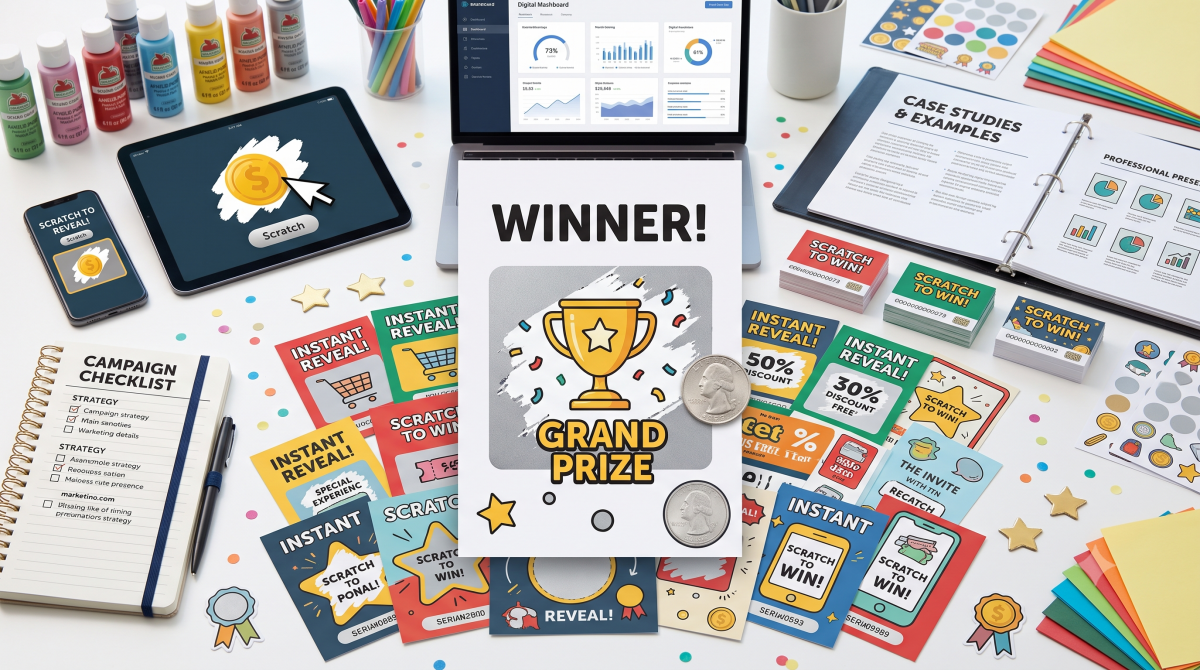
A scratch card promotion takes the same irresistible “I have to know if I won” instinct that powers lottery tickets and turns it into a marketing engine for your business. Hand someone a card with a hidden prize and they will scratch it — almost nobody can resist. That single behavioral fact is why scratch card promotions consistently out-pull plain coupons and ordinary mailers.
This guide is about the promotion itself — the campaign ideas, the prize structures, the real-world brand examples, and the step-by-step of running one that actually drives sales, foot traffic, leads, or loyalty. It’s the strategy companion to the more technical guides on where to print cards and how to make them; here, the focus is purely on what makes a scratch card promotion work.
Quick answer: What is a scratch card promotion? A scratch card promotion is a marketing campaign where customers scratch a hidden panel on a card to instantly reveal a prize, discount, or message. Businesses use them to drive foot traffic, boost sales, generate leads, reward loyalty, and create buzz. They work because the reveal mechanic triggers curiosity and excitement, producing 30–50% higher response rates than plain coupons or standard direct mail.
Why Scratch Card Promotions Work So Well
Scratch card promotions tap a behavioral principle borrowed straight from gaming: the thrill of a hidden, uncertain reward. The same “gambling” psychology that makes lottery scratchers so successful can be redirected into a marketing tool that gets customers to engage, act, and come back.
The numbers back it up. Interactive promotions like scratch off cards deliver 30–50% higher response rates than plain coupons or standard direct mail, and they can boost engagement by 40% or more. When added to direct mail, the scratch element revives a channel customers already trust — physical mail achieves roughly a 90% open rate versus 20–30% for email, and adding a tangible incentive lifts response further.
The mechanics that make it work:
- Curiosity — a hidden panel creates an information gap the brain wants to close.
- Anticipation — the few seconds of scratching build suspense no flat ad delivers.
- Earned value — a discount someone wins feels more valuable than the same discount simply handed over, so they’re more likely to redeem it.
- Guaranteed participation — by design, a scratch card requires the recipient to hold, view, and act on it.
Do scratch card promotions actually work? Yes. Interactive promotions like scratch off cards generate 30–50% higher response rates than plain coupons or standard direct mail and can lift engagement by 40% or more. The reveal mechanic compels participation — people almost always scratch a card they’re given — which is why everyone from local restaurants to major brands uses scratch card promotions to drive measurable results.
12 Proven Scratch Card Promotion Ideas
Here are the campaign types that work most reliably, organized by what they’re best at achieving.
Ideas That Drive Foot Traffic & Sales
- Mystery Discount. The classic. Every card hides a discount (e.g., 10%–50% off), but customers can only scratch to reveal it at your register or store. Because they’re guaranteed at least the minimum discount — with a chance at much more — it reliably pulls people in and seals the sale.
- Bounce-Back / Come-Back Campaign. Hand the card out as customers leave, telling them they can’t scratch it until their next visit. This manufactures a reason to return.
- Scratch, Match & Win. Customers scratch to find matching symbols; matches win a prize. Great for adding a game layer to a sale.
- Product Launch Buzz. Feature new products as the prizes to drive trial of those specific items.
Ideas That Generate Leads & Data
- Code-to-Enter (Digital Tie-In). The card reveals a unique code customers enter on a landing page or app to see if they’ve won — capturing email and contact data in the process.
- Scratch & Share (Social). Encourage winners to post their reveal with your hashtag for a bonus entry, driving organic reach.
- Trade Show / Event Capture. Hand a card to every booth visitor; they scratch at your booth and provide contact details to claim, collecting names and emails while creating buzz.
Ideas That Build Loyalty & Retention
- Frequent-Shopper Reward. Customers earn a scratch card after a set number of visits or a spending threshold (e.g., the fifth visit), revealing a reward.
- Collect-to-Complete. Hand out cards with each sale; once a customer collects enough to spell a word or reach a total, they claim a bigger prize.
- Customer Appreciation Day. Reward loyal customers with exclusive scratch-off deals on a special day.
Ideas for Internal & Community Goals
- Employee Safety / Incentive Program. Reward positive behavior or safety milestones with scratch cards — a documented use case for boosting morale and reducing incidents.
- Fundraiser / Seasonal Campaign. Tie scratch cards to a holiday or cause; themed designs (Valentine’s, summer, back-to-school, holidays) drive urgency, and December is a documented peak for scratch-off interest.
Real Brand Examples of Scratch Card Promotions
You don’t have to take the concept on faith — major brands have run scratch card promotions to hit specific goals. These examples (compiled from industry case studies) show the range.
| Brand | Goal | What They Did |
|---|---|---|
| JCPenney & Macy’s | Drive return customers | “Mystery discount” scratch-offs distributed in mail, newspaper inserts, or at checkout |
| Wendy’s | Launch new products | “Fresh-Made Breakfast” scratch, match & win promotion featuring new menu items as prizes |
| Heineken | Generate leads | “Skyfall 007 — crack the case” promotion; consumers revealed a code and entered it online |
| Papa John’s | Online redemption & data | Scratch-off codes redeemed on their website for a specialty pizza |
| Liberty Tax | Upsell services | Scratch-and-win cards offering discounts on credit monitoring, audit protection, and tax-return loans |
| Jackson Hewitt | In-store traffic | “Lucky number match” — customers brought cards in store to match a number to an offer |
| Bosch | Sales incentive | Scratch-off cards based on tool sales, with guaranteed winning odds and 1,000+ prizes |
| Monsanto | Workplace safety | “We caught you doing something SAFE AT WORK” reward cards |
The pattern across all of them: define one clear goal first — sales, leads, launch buzz, or behavior change — then design the prize and the redemption rule to serve it.
How to Structure Prizes for a Scratch Card Promotion
The prize structure is where promotions are won or lost. The goal is to make everyone feel like a winner while protecting your margins.
The “Everyone Wins” Model
A proven framework is roughly 70% small prizes, 25% medium prizes, and 5% grand prize. Guaranteeing that every card reveals something keeps participation high and ensures people redeem rather than discard. Reserve the rare grand prize to create buzz, but make the common small prize genuinely worth claiming. Many printers let you set multiple prize tiers (often up to 6–10) and control the exact quantity of each, so you can engineer your odds and budget precisely.
What prizes should I put on a scratch card promotion? Use an “everyone wins” structure — about 70% small prizes (a free add-on, 10% off), 25% medium prizes (a free item, 25% off), and 5% grand prize (a big discount or free product). Common winning messages include “10% off,” “Free Gift,” “Buy 1 Get 1 Free,” “Free Appetizer,” and “$10 off your next $50 order.” Match the prize to your goal: discounts drive sales, free items drive trial, big prizes drive buzz.
Match the Prize to the Goal
- Drive immediate sales → percentage or dollar discounts redeemable now.
- Drive repeat visits → “next visit” offers and bounce-back rewards.
- Drive trial → free samples or new-product giveaways.
- Drive buzz → a rare, high-value grand prize worth talking about.
- Reward employees → gift cards, paid time off, free lunch, or company swag.
Physical vs. Digital Scratch Card Promotions
Scratch card promotions come in two flavors, and many of the best campaigns combine them.
Physical cards are tangible, mailable, and ideal for in-store, direct mail, event, and packaging-insert promotions. They satisfy the desire for physical interaction and stand out in a mailbox.
Digital scratch cards are scratch-to-reveal experiences on a phone or website. They’re cheaper to distribute, eco-friendly, instantly shareable, and easy to tie to data capture and CRM systems. The most familiar example is the reward model used by payment apps: a Paytm scratch card, for instance, is a digital reward earned after an eligible transaction, found in the app’s “Cashback & Offers” section, which the user swipes to reveal cashback, points, or a voucher. Google Pay and PhonePe use the same mechanic. It’s a masterclass in using the scratch reveal to reinforce a desired behavior (making transactions) at massive scale.
The hybrid play: Put a QR code under a physical panel. The customer scratches, scans, and lands on a mobile page where they enter to win or redeem — combining the tactile thrill of paper with the tracking and data capture of digital.
Where do I find my Paytm scratch card? Open the Paytm app, tap “Cashback & Offers” on the home screen (or search “Cashback”), then select “Scratch Cards” to view cards you’ve earned. Swipe to reveal the reward — cashback, cashback points, or a voucher. Cards are typically credited within 24–48 hours of an eligible transaction and have an expiry date, so redeem them before they lapse.
Scratch Cards as Promotional Products
Beyond printed marketing cards, scratch-offs are a popular promotional-product category in their own right — handed out like branded swag at trade shows, events, and community functions. Promotional-product suppliers offer themed scratch cards (patriotic/American-made, sports-themed for big games, holiday designs), custom graphics printed on top of the scratch panel, and bulk discounts that deepen at tiers like 1,000, 3,000, 5,000, and 10,000 units. Because they’re affordable, interactive, and almost guaranteed to be engaged with, scratch cards make a booth the one people remember — and unlike a stress ball or pen, every card carries an offer that pulls the recipient toward your business.
How to Run a Scratch Card Promotion: Step by Step
- Define one clear goal. Sales, foot traffic, leads, loyalty, launch buzz, or behavior change. Everything else follows from this.
- Choose the mechanic. Mystery discount, match-and-win, code-to-enter, bounce-back, collect-to-complete — pick the one that fits the goal.
- Design the prize structure. Use an everyone-wins model; set tiers and quantities to control odds and budget.
- Set clear rules. Expiration date, eligibility (“one per customer,” “valid on purchases over $50”), and redemption instructions. Transparent terms prevent confusion and disputes.
- Add tracking. Unique codes or QR scans so you can measure redemption and attribute revenue.
- Choose distribution. In-store handout, direct mail, EDDM, packaging insert, event giveaway, or digital — matched to where your customers are.
- Promote the promotion. Amplify with social media, email, and in-store signage so people know to participate.
- Build in urgency. A deadline and a clear call to action drive timely redemption.
- Measure and iterate. Track redemption rates and revenue; refine the offer and prize mix for the next run.
How do I make a scratch card promotion successful? Start with one clear goal, then design the prize structure and redemption rule to serve it. Make every card a winner with an “everyone wins” mix, add unique codes or QR tracking to measure results, set a clear expiration date and call to action, distribute where your customers are, and amplify with social and email. Track redemption and refine for next time.
Common Mistakes to Avoid
- No clear goal. A promotion without a defined objective can’t be designed well or measured.
- Too many big winners. If everyone wins the grand prize, it’s just a margin-destroying markdown. Keep it rare.
- Weak offers. Even the smallest prize must feel worth claiming, or cards get tossed.
- No tracking. Without codes or QR scans, you can’t prove ROI or learn what worked.
- No expiration date. Urgency drives redemption; an open-ended offer gets forgotten.
- Unclear rules. Ambiguous terms cause disputes at the register and erode goodwill.
- Promoting a multi-prize award as a single lump sum. Be transparent that prizes are distributed across many winners.
- No call to action. Tell people exactly what to do after they scratch.
Frequently Asked Questions
What is a scratch card promotion?
A marketing campaign where customers scratch a hidden panel to reveal a prize, discount, or code. Businesses use them to drive sales, foot traffic, leads, and loyalty because the reveal mechanic compels participation.
Do scratch card promotions work?
Yes — they deliver 30–50% higher response rates than plain coupons or standard direct mail and can boost engagement by 40% or more, which is why brands from local shops to JCPenney, Wendy’s, and Heineken use them.
What’s a good prize structure?
An “everyone wins” mix of about 70% small prizes, 25% medium, and 5% grand prize. Guaranteeing every card wins something keeps participation and redemption high.
How much do scratch cards for a promotion cost?
Custom printed cards typically run about $0.12–$2.00 each depending on quantity and features, with bulk discounts at 1,000+. Digital scratch card promotions can be created with online tools for free or low cost.
What discounts should I offer?
Common winning offers include 10%–50% off, “Free Gift,” “Buy 1 Get 1 Free,” free food or service items, and dollar-off thresholds like “$10 off your next $50.” Match the offer to your goal.
Can I run a scratch card promotion online?
Yes. Digital scratch cards let users scratch to reveal on a phone or website, are easy to share and track, and can capture leads. You can also pair a printed card with a QR code for a physical-digital hybrid.
What is a Paytm scratch card?
A digital reward earned after eligible transactions in the Paytm app, found in “Cashback & Offers,” that you swipe to reveal cashback, points, or a voucher. It’s an example of a digital scratch promotion used to reinforce customer behavior at scale.
Where do I find my Paytm scratch card?
In the Paytm app, tap “Cashback & Offers” on the home screen, then “Scratch Cards.” Cards are usually credited within 24–48 hours of an eligible transaction and expire, so redeem promptly.
How do I track a scratch card promotion’s results?
Use unique codes or QR codes tied to a landing page so you can measure redemption, attribute revenue, and identify your best distribution channels.
Are scratch cards good for trade shows?
Very. As promotional products they almost guarantee engagement, draw visitors to your booth, and double as a lead-capture tool when redemption requires contact details.
How long should the promotion run?
Always set an expiration date to create urgency. Tie the window to your business cycle or a seasonal peak (December is a documented high point for scratch-off interest), and keep it short enough to prompt action.