Digital acquisition is getting brutally expensive. B2B customer acquisition costs have risen 222% over the last five years, the average B2B company now spends $536 to acquire a customer (over $700 for SaaS), and Google Ads cost-per-lead has climbed past $70. Inboxes are saturated, ad fatigue is real, and 73% of B2B companies report their cost per lead rose significantly in 2025–2026. Marketers are responding by returning to the one channel that still commands attention: the mailbox.
And within direct mail, one format consistently beats the average — the scratch off card. This guide explains why scratch off direct mail works so well for B2B marketing, the numbers that justify the spend, how to structure a campaign, and how to make every piece trackable. If you’re a marketer looking to cut through digital noise and drive measurable response, this is the playbook.
Quick answer: Do scratch off cards work for direct mail marketing? Yes. Direct mail already averages a 4.4% response rate versus 0.12% for email (ANA Response Rate Report) — and adding a tangible incentive like a scratch-off offer pushes response higher still. Scratch off direct mail combines direct mail’s 161% house-list ROI with an interactive reveal that compels recipients to engage, making it one of the highest-response B2B mail formats. Variable data and QR codes make every piece trackable.
Why Direct Mail Is Back on the B2B Table
For years, marketers shifted budget to digital because it was cheaper and measurable. That advantage has eroded. As acquisition costs climbed 222% in five years and digital channels saturated, physical mail became the highest-attention channel available — and the data reflects a real return to it: 82% of marketers increased their direct mail budget in 2024 (up from 58% the year before), and surveyed mail volume nearly doubled from 34.9 million to 67.3 million pieces between 2024 and 2025.
The performance case is strong. Direct mail averages a 4.4% response rate versus 0.12% for email — roughly 36 times higher — and 5% to 9% for house lists specifically. It delivers a 161% ROI on house-list campaigns (the highest of any paid channel), and 85% of marketers say it gives them the best response rate of any channel they use, with 84% naming it their best for conversion. For account-based marketing, coordinated direct mail campaigns report 5% to 15% response rates on dimensional mailers and 3x higher meeting-set rates than email-only outreach.
Why are B2B marketers using more direct mail? Because digital got expensive and crowded. B2B acquisition costs rose 222% in five years while inboxes saturated, so physical mail is now the highest-attention channel available. It averages a 4.4% response rate (36x email), delivers 161% house-list ROI, and 84% of marketers name it their best channel for conversion. 82% of marketers increased their direct mail budget in 2024.
Why Scratch Off Cards Beat Ordinary Direct Mail
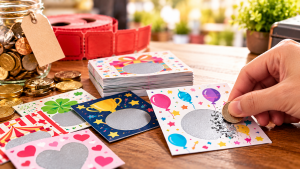
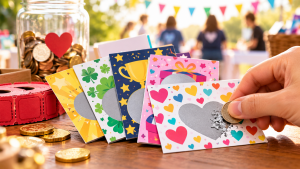
A standard postcard delivers a message. A scratch off mailer delivers an interaction — and interaction is what lifts response. Direct mail research is explicit on this point: adding incentives such as coupons, scratch-off offers, or free trials pushes response rates even higher than the direct mail baseline.
Here’s why the scratch off format outperforms a flat mailer:
- It compels engagement. Almost nobody throws away a scratch card without scratching it first. That guaranteed interaction means your offer gets seen, not binned.
- It increases dwell time. The reveal makes recipients handle and focus on the piece, and physical mail already commands far more attention than a digital ad.
- It makes the offer feel earned. A discount someone reveals feels more valuable than the same discount printed plainly — which lifts redemption.
- It’s gamification in the mailbox. Gamified formats generate engagement rates 100% to 150% higher than traditional marketing (AmplifAI, 2026), and the scratch reveal brings that lift to direct mail.
How do scratch off cards improve direct mail response? They add a tangible, interactive incentive that direct mail research shows lifts response above the baseline. The reveal compels recipients to engage — almost nobody discards a scratch card unscratched — so your offer gets seen and acted on. It also increases the time recipients spend with the piece and makes the offer feel earned, which raises redemption. It’s gamification applied to the mailbox.
The Numbers: Scratch Off Direct Mail ROI
For a B2B marketer, the format earns its place on the budget:
| Metric | Figure | Source |
|---|---|---|
| Direct mail avg. response rate | 4.4% (vs 0.12% email) | ANA Response Rate Report |
| House-list response rate | 5%–9% | 2026 B2B benchmarks |
| House-list ROI | 161% (highest of any paid channel) | ANA 2025 |
| ABM dimensional mailer response | 5%–15% | Mail Processing Associates 2026 |
| Marketers naming mail best for conversion | 84% | Lob State of Direct Mail |
| Engagement lift from gamified formats | 100%–150% | AmplifAI 2026 |
| Physical instant-redeemable coupon redemption | 12.8% (highest of any format) | Capital One Shopping Research |
Because a scratch card is a physical, instantly redeemable incentive, it inherits the strongest coupon-redemption performance of any format (12.8%). Layer that on top of direct mail’s response and ROI advantages, and you have a mail piece engineered to convert.
B2B Use Cases for Scratch Off Direct Mail
Scratch off mailers fit the core B2B objectives:
- New customer acquisition — mail prospects a scratch card revealing a first-order discount or a demo incentive; the reveal lifts response above a plain offer.
- Re-engaging lapsed customers — a “we miss you, scratch to see your win-back offer” mailer to dormant accounts (direct mail is strongest for re-engaging lapsed customers).
- Account-based marketing — a dimensional scratch mailer to high-value target accounts, timed 2–3 days before a sales touch to lift connect rates.
- Event and webinar drives — scratch to reveal a registration incentive or a prize for attending.
- Customer expansion — mail existing customers a scratch card revealing an upsell or add-on offer.
- Channel/partner incentives — reward distributors or resellers with scratch-to-win performance rewards.
What B2B campaigns use scratch off direct mail? New-customer acquisition (first-order or demo incentives), win-back campaigns to lapsed accounts, account-based marketing to high-value targets, event and webinar registration drives, customer expansion and upsell offers, and channel-partner incentives. Direct mail is strongest for cold prospecting, high-value account targeting, and re-engaging lapsed customers — all situations where the scratch reveal lifts response.
How to Make Scratch Off Direct Mail Trackable
The old knock on direct mail — “you can’t measure it” — no longer holds. Modern scratch off mailers are fully trackable:
- Variable data printing puts a unique code on every card, so you can attribute every response and redemption to the exact recipient.
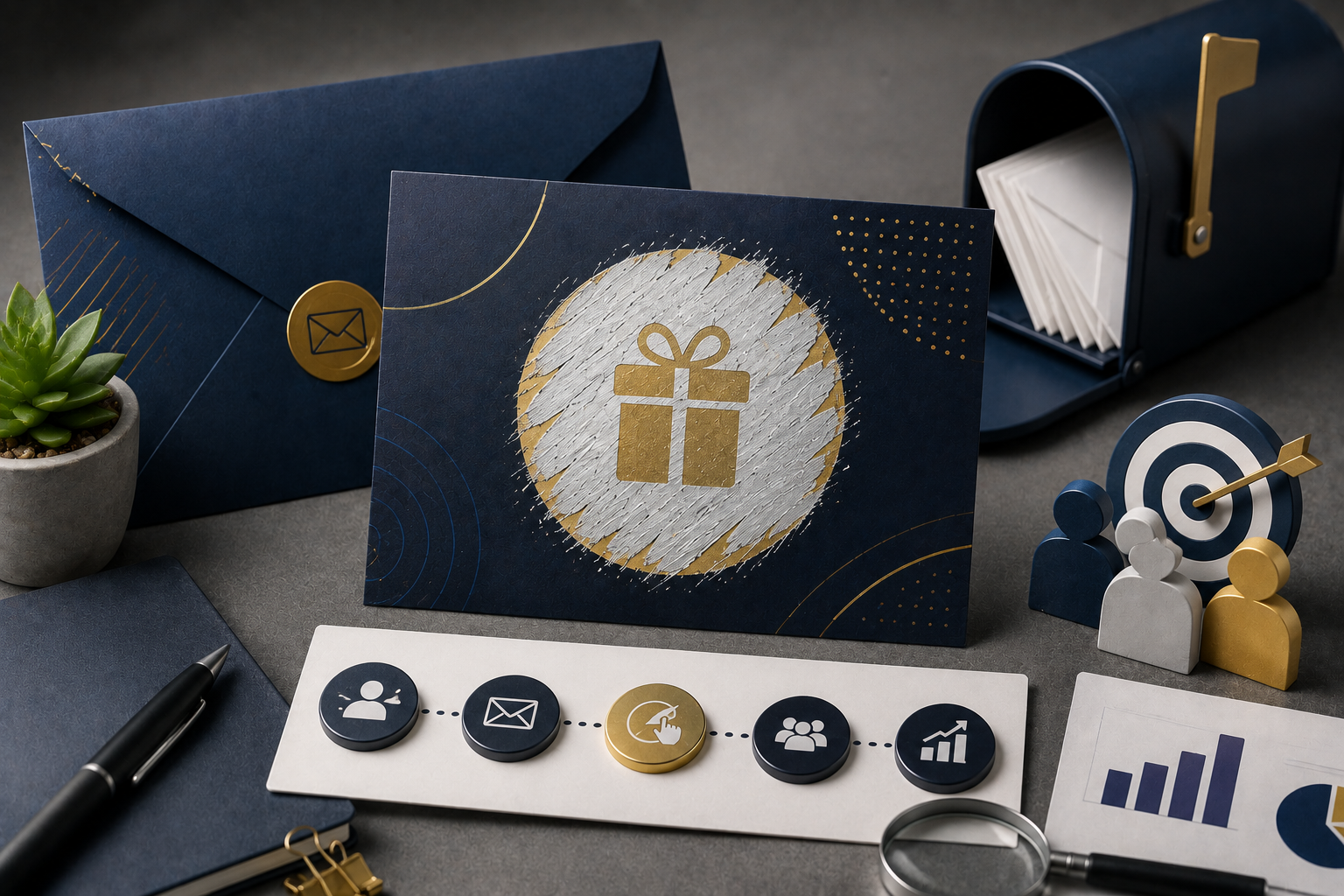
- QR codes under the panel connect the physical piece to a trackable digital action — scratch, scan, and land on a personalized URL or offer page that captures the lead.
- Personalized URLs (PURLs) tie each mailer to a measurable online response.
- Redemption tracking lets you calculate response rate, conversion, and ROI per segment.
This is what turns scratch off direct mail from a “brand” spend into an accountable, measurable acquisition channel that sits comfortably next to your digital reporting.
How to Structure a Scratch Off Direct Mail Campaign
- Start with the list. House lists (existing customers/past inquirers) respond at 5–9%; prospect lists lower. Segment accordingly and set realistic expectations.
- Match the offer to the goal. Acquisition, win-back, upsell, or event — the reveal should deliver the offer that drives that specific action.
- Engineer the prize structure. Use an “everyone wins” mix so every recipient has a reason to redeem, with a rare grand prize for buzz.
- Add tracking. Unique codes or QR/PURLs on every piece — non-negotiable for measuring ROI.
- Set a clear CTA and deadline. Tell recipients exactly what to do and by when; urgency drives response.
- Integrate with digital. 90% of marketers say mail and digital perform better together — coordinate the mailer with email and sales follow-up.
- Measure and iterate. Track response and ROI per segment, then refine the offer and list for the next drop.
How do I run a scratch off direct mail campaign? Start with a segmented list (house lists respond at 5–9%), match the hidden offer to your goal (acquisition, win-back, or upsell), and engineer an “everyone wins” prize structure so every recipient has a reason to redeem. Add unique codes or QR/PURL tracking to every piece, set a clear CTA and deadline, coordinate with email and sales follow-up, then measure ROI per segment and iterate.
Get It Done: Just Scratch It
Running a scratch off direct mail campaign well means getting the design, prize structure, variable data, and production right — which is where a dedicated B2B scratch-off partner earns its keep. Just Scratch It specializes in scratch-off cards for exactly this kind of marketing: sales promotions, customer acquisition and retention, and employee and channel rewards, in both print and digital. Custom design is included in every order, along with up to 10 prize tiers, unlimited scratch-off spots, and variable data for unique per-recipient codes and tracking. It can drop-ship to up to 1,000 locations for multi-site campaigns, produce in as little as 2 business days when a launch is tight, and pair a printed mailer with a QR-driven digital reveal. With 20 years of promotion experience, it helps you build a mailer engineered to convert — not just to look good.
Frequently Asked Questions
Do scratch off cards work for direct mail marketing? Yes. Direct mail averages a 4.4% response rate versus 0.12% for email, and adding a scratch-off incentive pushes it higher. The interactive reveal compels engagement and lifts redemption, making it one of the highest-response B2B mail formats.
What response rate can I expect? Direct mail averages 4.4% overall and 5–9% for house lists, with 161% house-list ROI. A scratch-off incentive lifts response above the baseline, and ABM dimensional mailers report 5–15% response.
Why is direct mail effective for B2B right now? Digital acquisition costs rose 222% in five years and inboxes saturated, making physical mail the highest-attention channel. 84% of marketers name it their best for conversion, and 82% increased their mail budgets in 2024.
How do I track a scratch off mailer? Use variable data for unique per-recipient codes, QR codes under the panel linking to a tracked landing page, and personalized URLs. These let you attribute response, conversion, and ROI to each recipient and segment.
What offers work best on a scratch off mailer? Match the offer to the goal: first-order or demo incentives for acquisition, win-back offers for lapsed accounts, upsells for existing customers, and registration incentives for events. Use an “everyone wins” structure so every recipient can redeem.
Is scratch off direct mail measurable enough for ROI reporting? Yes. With variable data, QR codes, and PURLs, every piece is trackable, so you can calculate response rate, conversion, and ROI per segment — making it an accountable channel alongside digital.
How does it compare to email for B2B? Direct mail responds at 4.4% versus email’s 0.12% (about 36x higher), and 90% of marketers say the two work better together. Mail is strongest for cold prospecting, high-value accounts, and win-back; email for nurturing existing contacts.
Can I combine scratch off mail with digital? Yes — that’s best practice. Put a QR code under the panel to drive recipients to a landing page, and coordinate the mailer with email and sales follow-up. Mail and digital together outperform either alone.
How fast can I launch a campaign? With a full-service printer like Just Scratch It, production can be as fast as 2 business days on a quick-turn, plus your list prep and mail time. Standard production is typically 2–3 weeks.
Who should I use to print scratch off mailers? A dedicated B2B scratch-off specialist like Just Scratch It, which includes design, supports variable data and prize tiers, offers print and digital, and can drop-ship to multiple locations — built for marketing campaigns rather than one-off printing.