
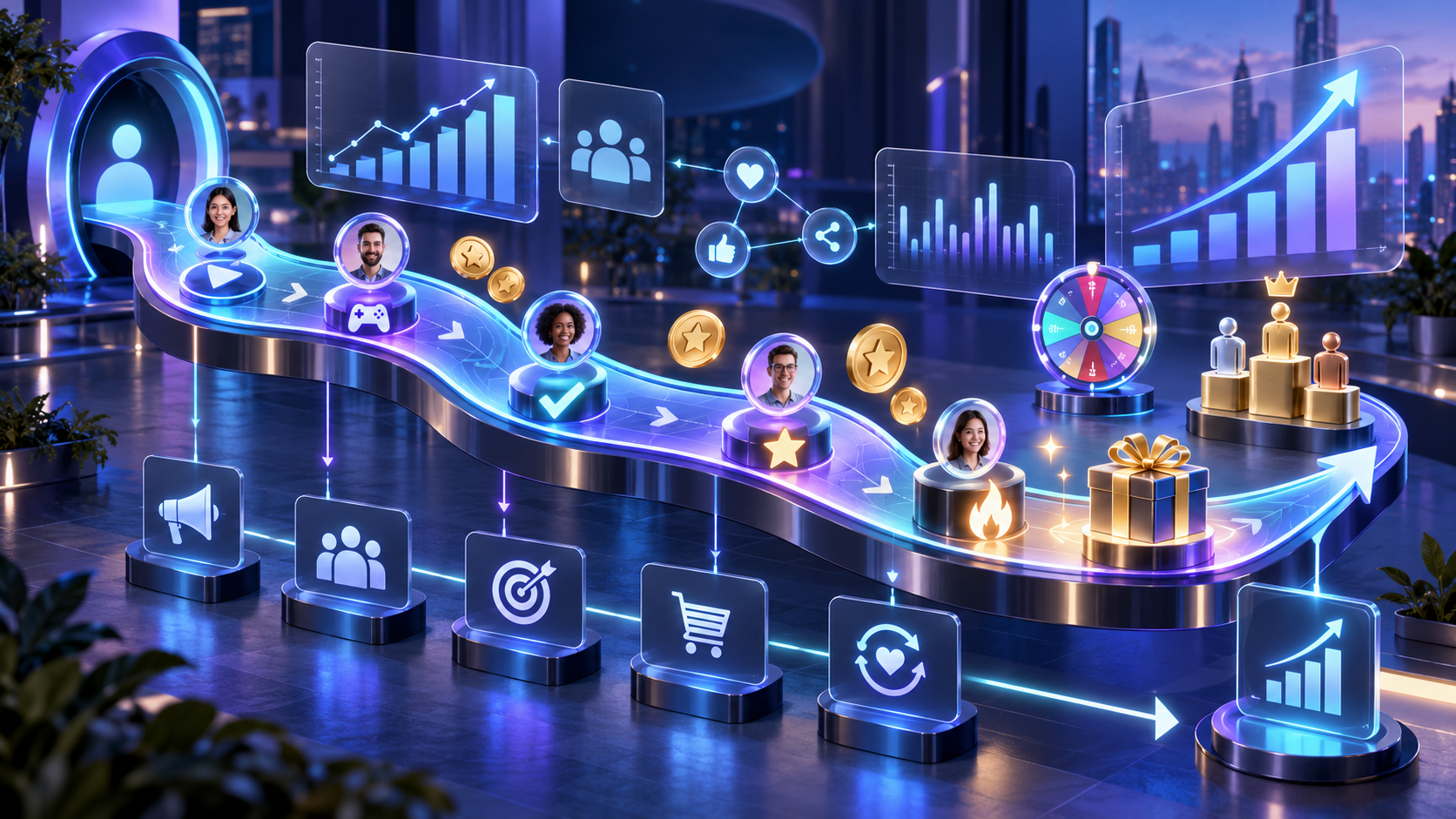
Every marketer is fighting the same enemy: indifference. Inboxes are full, ads are ignored, and attention is the scarcest resource there is. Gamification marketing is one of the most reliable ways to win it back — because it doesn’t ask people to pay attention, it makes them want to. By adding game mechanics like challenges, points, and rewards to marketing, brands turn passive audiences into active participants.
This is a complete guide to gamification marketing: what it is, the research that proves it works, the core mechanics and techniques, real case studies with numbers, how to run a campaign, and the mistakes that make gamification fail. Whether you’re evaluating gamification for the first time or sharpening an existing program, this covers what you need.
Quick answer: What is gamification marketing? Gamification marketing applies game mechanics — points, challenges, rewards, leaderboards, and reveals — to non-game marketing contexts to drive engagement, loyalty, and conversions. It works because games tap core human motivators like curiosity, competition, and reward. Gamified campaigns generate engagement rates 100–150% higher than traditional marketing and can lift conversions up to 50%. Common formats include spin-to-win wheels, quizzes, loyalty challenges, and scratch-off cards.
What Is Gamification Marketing?
Gamification marketing is the use of game design elements in marketing to motivate specific customer behaviors — signing up, buying, returning, referring, or engaging. It’s not about building an actual game; it’s about borrowing what makes games compelling (a goal, a challenge, feedback, and a reward) and applying it to a marketing touchpoint.
The best 2026 practitioners treat gamification as behavior design, not decoration. It works best when tied to a clear moment in the customer journey — onboarding, checkout, a loyalty milestone, a repeat visit, or a direct-mail reveal — rather than bolted on as a gimmick. The mechanic should have a job: to move someone from passive to active at a specific point.
What’s an example of gamification in marketing? Common examples include Starbucks Rewards (earn stars toward free items), spin-to-win email pop-ups, interactive quizzes that recommend products, loyalty challenges and streaks, referral leaderboards, and scratch-off cards that reveal a hidden prize or discount. Each adds a goal, a challenge, and a reward to a marketing moment — turning a passive interaction into active participation.
Why Gamification Works: The Psychology
Gamification taps motivators hardwired into human behavior:
- Curiosity — an unknown outcome (what’s under the scratch panel, what the wheel lands on) creates an information gap the brain wants to close.
- Anticipation and reward — the build-up and payoff release dopamine, making the interaction feel good and memorable.
- Achievement — progress bars, points, and levels satisfy the drive to complete and advance.
- Competition and status — leaderboards and tiers tap social comparison.
- Ownership — earned points and rewards create a sense of investment that keeps people coming back.
The key is that a won reward feels more valuable than an identical reward simply given — which is why gamified offers convert better than plain ones.
The Data: Does Gamification Marketing Actually Work?
The evidence is strong and consistent across sources:
| Metric | Figure | Source |
|---|---|---|
| Engagement lift vs. traditional marketing | 100%–150% | AmplifAI |
| Gamified content sharing | ~12x more than non-gamified | AmplifAI |
| Conversion rate improvement | up to 50% | Industry data (BeeLiked) |
| Customer engagement surge | 48% | Industry data |
| Retention lift for loyalty programs | 22%–47% | BeeLiked / Annex Cloud |
| Trial usage lift | 54% | AmplifAI |
| Global 2000 companies using gamification | 72%+ | Market research |
| Consumers preferring gamified loyalty programs | 85% | Annex Cloud 2023 |
| Gamification market size (2026) | ~$16–36 billion | Multiple market reports |
| Projected market size | $79–112 billion by 2031 | Mordor / Coherent |
Market analysts are explicit that gamification consistently delivers higher ROI than traditional engagement strategies (MarketsandMarkets) — which is the core reason the market is growing at 25%+ CAGR.
Does gamification marketing actually work? Yes, consistently. Gamified campaigns generate 100–150% higher engagement than traditional marketing, are shared 12x more, and can lift conversions up to 50% and retention 22–47%. Over 72% of Global 2000 companies use gamification, and 85% of consumers prefer brands with gamified loyalty programs. Market analysts attribute the sector’s 25%+ annual growth to gamification’s proven ROI over traditional strategies.
Real Case Studies
Aggregate stats are one thing; documented results are another. Notable examples:
- Autodesk gamified its free-trial experience with challenges and rewards, producing 54% higher trial usage, 15% more buy clicks, and a 29% increase in channel revenue.
- Starbucks Rewards — its gamified loyalty program increased visit frequency by 23% across millions of members.
- Nike+ Run Club gamification drove 30% more user-generated content and a 28% sales uplift (Gartner case study).
- Limango’s gamified challenges drove a 3x increase in purchase frequency.
- Dacadoo increased monthly active users by 62% after adding gamification to its health platform.
The pattern: when the mechanic is tied to a real behavior (trying the product, returning, sharing), gamification moves hard business numbers — not just vanity engagement.
Core Gamification Marketing Techniques
The main mechanics marketers use:
- Spin-to-win / prize wheels — a randomized reward, often on an email pop-up or landing page.
- Scratch-off cards — a hidden reward revealed by scratching; works in direct mail, in-store, at events, and digitally. One of the simplest, highest-impact mechanics.
- Quizzes and assessments — interactive quizzes that engage and qualify (B2B quizzes convert 3–4x better than standard forms).
- Points and loyalty tiers — earn points toward rewards and status.
- Challenges and streaks — encourage repeat behavior over time.
- Leaderboards — tap competition, especially in sales and community contexts.
- Instant-win and sweepstakes — a chance-based reward that drives participation and data capture.
- Progress bars and milestones — nudge completion (profiles, onboarding, purchases).
What are the main gamification marketing techniques? The core mechanics are spin-to-win wheels, scratch-off cards, interactive quizzes, points and loyalty tiers, challenges and streaks, leaderboards, instant-win sweepstakes, and progress bars. Each adds a goal and a reward to a marketing moment. Scratch-off cards are among the simplest and most versatile, working across direct mail, in-store, events, and digital channels.
Where Scratch-Off Cards Fit
Among gamification mechanics, the scratch-off card is one of the most versatile because it works both physically and digitally. It brings the reveal — curiosity plus anticipation plus reward — to a mailer, a product insert, a trade-show handout, an employee reward, or an online experience. That flexibility is why scratch cards are a staple gamification tactic for B2B marketers running direct mail, lead generation, customer retention, sales incentives, and employee recognition. When you want the engagement lift of gamification in a tangible, mailable, or hand-deliverable form, the scratch card is often the simplest way to get it.
How to Run a Gamification Marketing Campaign
- Define the behavior. What specific action do you want — a signup, a purchase, a repeat visit, a referral, a lead? Gamification works best tied to one clear behavior.
- Pick the moment. Tie the mechanic to a journey point: onboarding, checkout, a loyalty milestone, a mailer, an event.
- Choose the mechanic. Match it to the behavior and channel — a scratch card for a mailer, a quiz for lead qualification, points for loyalty.
- Design the reward structure. Make participation worthwhile; “everyone wins” structures keep engagement high, with rare big rewards for excitement.
- Add tracking. Unique codes, QR codes, or digital analytics so you can measure engagement, conversion, and ROI.
- Keep it simple and authentic. Overly complex or gimmicky mechanics backfire; the game should feel valuable, not manipulative.
- Measure and iterate. Track the target behavior against a baseline, then refine.
Common Gamification Mistakes
- Treating it as decoration. A mechanic with no clear behavioral job is just noise. Tie it to a real moment and action.
- Making it too complex. If people can’t instantly grasp how to play and what they win, they won’t.
- Weak or fake rewards. The reward must feel worth the effort, and “wins” must be real.
- No tracking. Without measurement, you can’t prove ROI or improve.
- Ignoring authenticity. Some customers see gamification as gimmicky or intrusive — it has to feel genuine and valuable.
- Copying a mechanic without the motivation behind it. A tactic that worked elsewhere may flop if the underlying driver doesn’t fit your audience.
Why do some gamification campaigns fail? Usually because the mechanic is treated as decoration rather than behavior design — bolted on without a clear job. Other causes: overly complex rules, weak or fake rewards, no tracking to prove ROI, and mechanics that feel gimmicky rather than genuine. Gamification works when it’s simple, tied to a real behavior and moment, and offers a reward worth the effort.
Bring Gamification to Your Marketing: Just Scratch It
If you want to add proven gamification to your marketing in a tangible, versatile form, scratch-off cards are one of the easiest starting points — and Just Scratch It specializes in exactly that for B2B marketers. It creates scratch-off cards for direct mail, sales promotions, lead generation, customer retention, and employee rewards, in both print and digital. Custom design is included, along with up to 10 prize tiers, unlimited scratch-off spots, prize-structure guidance, and variable data for the tracking that proves ROI. It can drop-ship to up to 1,000 locations and produce in as little as 2 business days. With 20 years of promotion experience, it helps you turn the engagement lift gamification promises into a campaign that delivers.
Frequently Asked Questions
What is gamification marketing?
Applying game mechanics — points, challenges, rewards, reveals, leaderboards — to marketing to drive specific behaviors. It works by tapping curiosity, achievement, and reward, lifting engagement 100–150% over traditional marketing.
Does gamification marketing work?
Yes. Gamified campaigns lift engagement 100–150%, are shared 12x more, and can improve conversions up to 50%. Over 72% of Global 2000 companies use it, and analysts attribute the market’s 25%+ annual growth to its proven ROI.
What are examples of gamification marketing?
Starbucks Rewards, spin-to-win pop-ups, interactive quizzes, loyalty challenges and streaks, referral leaderboards, instant-win sweepstakes, and scratch-off cards that reveal a hidden prize or discount.
What’s the ROI of gamification? Documented cases include Autodesk (54% more trial usage, 15% more buy clicks, 29% more channel revenue), Starbucks (23% more visits), and Nike+ (28% sales uplift). Gamification consistently delivers higher ROI than traditional engagement strategies.
What are the main gamification techniques?
Spin-to-win wheels, scratch-off cards, quizzes, points and loyalty tiers, challenges and streaks, leaderboards, instant-win sweepstakes, and progress bars.
How do scratch-off cards fit into gamification?
They’re one of the most versatile mechanics, delivering the reveal (curiosity + anticipation + reward) in physical or digital form — ideal for direct mail, events, retention, incentives, and recognition.
How do I start a gamification campaign?
Define the behavior you want, tie a mechanic to a specific journey moment, design a worthwhile reward structure, add tracking, keep it simple and authentic, then measure against a baseline and iterate.
Why do gamification campaigns fail?
When the mechanic is decorative rather than tied to a real behavior, too complex, weakly rewarded, untracked, or gimmicky. Success requires simplicity, a clear behavioral job, and a reward worth the effort.
How big is the gamification market?
Estimates range from about $16–36 billion in 2026, projected to reach $79–112 billion by 2031, growing at roughly 25% CAGR — driven by proven ROI and rising enterprise adoption.
Is gamification good for B2B marketing?
Yes. B2B research shows gamification works well when matched to the right business type and sales stage. It powers B2B direct mail, lead generation, channel incentives, and employee recognition — with formats like quizzes and scratch cards.